
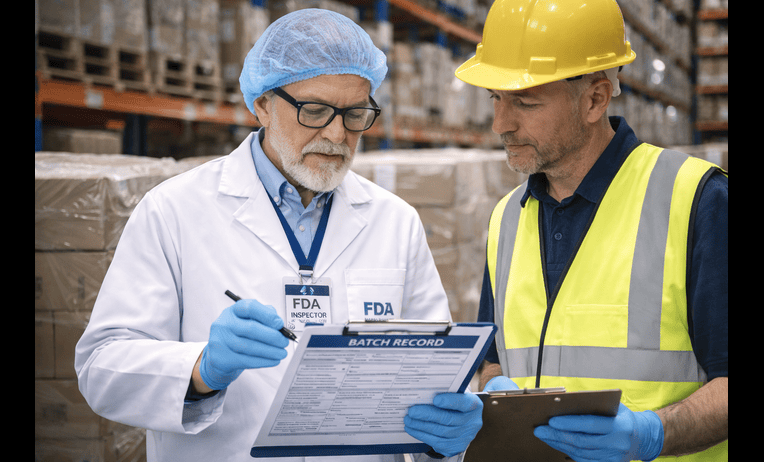
Imagine a surprise visitor arrives at your office, asks for production files from three years ago, and expects them in five minutes. For many organizations, an FDA inspection feels like a high-stakes pop quiz. In practice, however, the experience is much closer to a routine health inspection at a five-star restaurant. While common knowledge dictates what is regulated by the FDA ranging from our morning aspirin to canned goods, their actual “boots on the ground” safety mission is collaborative, focusing on proactive habits rather than simply catching mistakes.
The agency acts as a rigorous safety auditor rather than a legal adversary. Merely following an FDA regulation on paper is basic compliance; conversely, true FDA Inspection Readiness means living those quality standards daily. To ensure this public trust, visiting inspectors evaluate three core areas: your people, your everyday processes, and your written records.
From Bandages to Biologics: Understanding What the FDA Regulates and Why Inspections Matter
We trust our daily products are safe, but what does the FDA regulate exactly? The agency’s legal authority to enter facilities and enforce quality standards covers a massive range of consumer goods. This jurisdiction includes:
- Medical devices, from simple bandages to complex tools seeking a medical magnesium FDA breakthrough device designation.
- Cosmetics, such as your daily moisturizers and shampoos.
- Dietary supplements, packaged foods, and over-the-counter medicines.
Ensuring these safety promises are kept requires routine check-ups known as Surveillance Inspections. Think of these as standard, scheduled health appraisals for a manufacturing plant. Even highly advanced facilities utilizing FDA biologics approval services for new medications must undergo these standard visits to prove their everyday operations remain clean and compliant.
Conversely, if a sudden safety issue or consumer complaint arises, the agency triggers a For-Cause Inspection. This is a targeted investigation aimed at solving an immediate, specific problem rather than conducting a general wellness check. Whether an investigator arrives for a routine visit or an urgent concern, managing their presence requires structured preparation and a clear strategy for the facility walkthrough.
Inside the Inspection: Navigating the Front Room, Back Room, and the Investigator’s Walkthrough
When an investigator walks through your doors, a well-managed FDA Inspection relies on controlled communication, much like a restaurant separates its quiet dining area from a bustling kitchen. Companies achieve this using a “Front Room and Back Room” strategy. The Front Room is where the investigator sits and reviews records. Meanwhile, the Back Room operates as a command center, locating files and preparing staff.
To keep this system smooth, facilities rely on a specialized team:
- The Host: Guides the investigator and answers direct questions.
- The Scribe: Takes detailed notes on everything discussed.
- The Runner: Delivers requested documents from the Back Room.
This structured group helps companies meet the “5-minute rule” the goal of retrieving any requested file within five minutes. Whether accessing an internal FDA inspection database or pulling physical FDA inspection reports, quick retrieval proves your operations are highly organized.
What if the investigator asks you a question directly on the floor? Answer honestly and concisely without guessing. If you do not know the answer, simply state you will find the person who does. Consistency during these facility walkthroughs relies heavily on following established standard operating procedures.
The Recipe for Compliance: Why Standard Operating Procedures Are Your Facility’s Best Defense
Just as a bakery relies on a strict recipe to ensure every loaf tastes identical, companies use Standard Operating Procedures (SOPs) to guarantee safety. These written rules are your recipe for success, helping staff consistently meet rigorous FDA standards. By simplifying complex instructions, you empower employees to perform flawlessly. Yet, over time, workers might naturally adopt shortcuts to speed up their routine. This gradual deviation from the official rulebook is called “SOP Drift,” a dangerous vulnerability that investigators actively hunt for on the manufacturing floor.
Preventing this drift requires managers or external FDA quality and regulatory consultants to verify that daily actions perfectly match approved manuals. This exactness is vital everywhere, from the physical assembly line to engineering labs operating under FDA design controls 21 CFR 820.30 guidance. If an inspector spots a worker improvising, they immediately lose trust in your entire operation. Executing instructions correctly is merely half the process; permanent, accurate documentation proves your work to auditors.
The Golden Rule of Documentation: Proving Your Work Through Accurate Record-Keeping and Retrieval
In the regulated world, perfect execution means nothing without proof. The ultimate mantra is simple: if it isn’t written down, it didn’t happen. Inspectors rely on pristine FDA inspection data to verify safety, expecting you to retrieve specific records in minutes. Disorganized physical binders or clunky digital FDA TIMS (Technical Information Management Systems) create delays that instantly destroy an auditor’s trust.
To ensure paperwork survives scrutiny, professionals use a standard called ALCOA+ to guarantee complete data integrity. This framework dictates that every single log entry is:
- Attributable: Signed by the person who performed the work.
- Legible: Easy for anyone to read.
- Contemporaneous: Documented at the exact moment the task occurred, completely eliminating back-dated entries.
- Original: The primary source document, not a transcribed copy.
- Accurate: Truthful and error-free.
Mastering these principles prevents the panic of missing logs, but even prepared teams occasionally spot mistakes. Facilities often use external FDA compliance services to proactively audit their files and catch slips early. When a documentation error inevitably surfaces, the inspector watches your response. This leads directly to the critical process of fixing the underlying system, rather than simply trying to erase a mistake.
Closing the Feedback Loop: How Corrective and Preventive Actions (CAPA) Fix the System, Not Just the Mistake
Even the best facilities experience errors, but the FDA cares most about your response. Patching an immediate issue is merely a correction. Regulators expect you to go further by developing a Corrective and Preventive Action plan, commonly known as a CAPA. This feedback loop ensures you fix the system that caused the error, rather than just discarding one bad product.
Stopping repeat violations requires Root Cause Analysis to discover the hidden source of a failure. Think of a flat tire: changing the tire is the immediate correction, but removing the nail from your driveway is the preventive action. Facilities often utilize FDA QSR consulting to establish these essential investigative processes. By finding that metaphorical nail, you guarantee the underlying error won’t return.
Documenting self-identified mistakes actively demonstrates a healthy quality culture to inspectors. Auditors trust teams that hunt for weaknesses before they become major hazards requiring an FDA remediation consultant to resolve. If your internal system misses a critical issue, the auditor will officially document it on an FDA Form 483, requiring a prompt and effective response.
Decoding Form 483: How to Respond Effectively When an Inspector Finds a Flaw
Receiving an FDA inspection 483 feels alarming, but it is simply a formal list of concerns called observations noted during the walkthrough. Think of it as a home inspector’s punch list; it highlights areas needing repair, not an immediate violation. However, you face a strict 15-day deadline to reply. Missing this window can escalate a simple observation into a severe Warning Letter. Many companies search FDA inspection database 483 records to benchmark their specific issues against industry peers.
To construct a successful FDA Form 483 response strategy, your team must adopt a calm, non-defensive tone. Meeting these rigorous regulatory expectations internally can quickly overwhelm a staff, forcing facilities to decide whether they can manage these repairs alone or if they need outside guidance to safely navigate the regulatory maze. If you are handling the response internally, regulators expect your reply to contain three core elements:
- Acknowledgment: Accept the observation clearly without making excuses.
- Immediate Action: Detail exactly how you contained the current problem.
- Systemic Fix: Outline your plan to prevent recurrence permanently.
Knowing When to Call an Expert: How FDA Regulatory Consulting Firms Bridge the Knowledge Gap
When internal teams struggle, outside help is much safer than risking a facility shutdown. Investing in FDA regulatory consulting acts like an insurance policy. Instead of waiting for a real inspector, schedule a Mock Audit, a realistic practice run where experts examine your building exactly like the agency would. Choosing the right partner matters; companies actively seek the best FDA regulatory consulting for medical devices 2025 to guarantee their processes meet strict safety standards.
Specialized advisors also offer guidance long before inspections happen. If developing a new product, FDA Q-submission consulting helps submit blueprints to regulators for early feedback. Bridging this knowledge gap with external experts gives your staff confidence to handle routine compliance smoothly, allowing you to build internal resilience by transforming inspection prep from a crisis response into a daily habit.
Your 30-Day Readiness Roadmap: Transforming Inspection Prep from a Crisis into a Daily Habit
Instead of fearing a surprise knock at the door, you now have the tools to turn regulatory panic into process-driven confidence. Achieving true FDA Inspection Readiness means shifting away from stressful crisis mode and stepping into a state of permanent readiness. You can secure peace of mind through structured, documented compliance by starting this simple 30-day roadmap:
- Update SOPs to match your actual daily procedures.
- Train Staff to answer questions simply and honestly.
- Audit Logs to verify every record is properly signed.
- Clean Facility spaces to immediately project organized professionalism.
- Hire Coach (like an FDA compliance consultant) for a practice run.
By embedding these steps into a monthly internal audit schedule, readiness becomes a natural daily habit rather than a frantic scramble. You no longer need to view inspectors as threats. With established procedures and proactive habits, your team remains confident, compliant, and always prepared for any regulatory visit.