
CLIA Certification and Compliance Requirements Explained
Waiting for a critical cholesterol result or a rapid flu test from your neighborhood pharmacy can be stressful, but you likely trust that the final numbers are correct. According to federal health experts, that confidence is actively protected by a hidden safety net known as CLIA. Think of it like a restaurant’s health inspection grade; just as you wouldn’t eat at a diner with a failing score, you wouldn’t want a medical diagnosis based on unverified lab equipment.
The Clinical Laboratory Improvement Amendments (CLIA) acts as a standardized yardstick for medical accuracy across the country. If you have ever wondered what does CLIA stand for or what is CLIA, it refers to the federal program setting uniform testing standards. The true CLIA meaning boils down to a simple consumer promise: an accurate result in a massive hospital lab must be just as reliable as one from your local clinic. CLIA certification signals that a laboratory meets those quality benchmarks. Federal agencies—specifically the CMS, FDA, and CDC, cooperate to enforce these baseline standards.
Does it really matter who processes your blood sample? Because a false negative could easily delay essential treatment, the law requires strict oversight to prevent dangerous mix-ups and ensure your ongoing peace of mind. Every CLIA test is performed within a framework that prioritizes accuracy and patient safety.
Summary CLIA is the federal program that ensures accurate, reliable laboratory testing nationwide through uniform standards enforced by CMS, FDA, and CDC. Tests are categorized as waived, moderate, or high complexity, which drive the required certificate type, inspections, proficiency testing, staffing qualifications, and biennial renewal. Labs apply via CMS-116 to obtain a Certificate of Waiver, Compliance, or Accreditation (e.g., CAP) and may also need state-specific licenses. Patients can verify a lab’s status using its 10-digit CLIA ID in the public lookup and follow a safety checklist to confirm their samples are handled correctly.
Boiling Water vs. The Perfect Soufflé: Decoding Test Complexity Tiers
A rapid pharmacy swab takes five minutes, but a specialized blood panel leaves you waiting days because not all medical procedures carry the same risk. To keep patients safe, CLIA divides every test into three specific complexity tiers.
Think of these categories like different levels of cooking skills:
- Waived: Like boiling water, these are nearly foolproof. A common list of clia waived tests includes basic pregnancy checks and rapid COVID-19 swabs. If you have asked what is a clia waived test or which of the following is a clia waived laboratory test, it is any screening designated as low risk and simple to perform.
- Moderate: Similar to following a strict recipe, this tier requires specific tools and trained staff to safely perform routine chemistry panels.
- High: This is the perfect soufflé. It demands expert technicians and highly controlled environments to process complex genetics or cancer screenings.
The terminology can occasionally confuse patients, but the waived testing definition simply means a procedure is low-risk enough to safely skip the strictest federal inspections. A clia waived test is essentially any routine screening cleared for basic clinic use. The government grants a clia waiver for these specific procedures because the chance of a mistake causing severe harm is incredibly tiny.
Knowing this hierarchy explains why some health results are instant while others require shipping your sample to a massive, highly regulated facility. Yet, before any local clinic or large hospital performs even the simplest waived screening, they must prove they can operate safely. This requires navigating a strict application process, much like earning a driver’s license before hitting the open road.
The Lab’s ‘Driver’s License’: Navigating the Certification and Renewal Process
Just as a teenager can’t legally drive without passing a test, a medical facility cannot process your lab results without a federal permit. The journey begins with a specific document: the CMS-116 application process. Whether a neighborhood pharmacy wants to offer quick flu swabs or a major hospital needs to run complex bloodwork, this form serves as the universal starting line for fulfilling clia certification requirements and obtaining CLIA certification.
What happens after submitting the paperwork depends heavily on the testing complexity. A clinic planning to only perform simple, foolproof tests will submit a clia waiver application to earn a basic Certificate of Waiver. Conversely, a lab performing moderate or high-complexity work requires a Certificate of Compliance, triggering rigorous federal inspections. Many facilities also pursue accreditation through organizations such as the College of American Pathologists, resulting in CAP laboratory accreditation under a CLIA Certificate of Accreditation.
The roadmap for any medical facility typically follows four key steps:
- Apply: The facility submits the CMS-116 form detailing the specific tests they plan to offer.
- Verify: Federal health agencies review the clia application to confirm the lab meets basic safety standards.
- Inspect: For complex testing, inspectors physically visit the facility to evaluate their accuracy and procedures.
- Maintain: Every two years, facilities must complete a clia license renewal to stay in operation.
Moderate- and high-complexity sites must also enroll in proficiency testing programs (often called PT laboratory programs) to regularly verify performance. This ongoing proficiency testing, combined with inspections, ensures results remain dependable between renewals.
That strict two-year renewal cycle is your ongoing safety net, ensuring a lab’s approval isn’t just a one-time achievement. However, having top-notch equipment and an active certificate is only half the equation, because even the best machines require human expertise.
Who Is Reading Your Results? The People Behind the Microscope
Imagine walking into a high-end restaurant; you certainly wouldn’t want a trainee chef cooking a delicate soufflé. The same logic applies to your medical care. Federal law ensures that as medical tests become more complex, the individuals performing them must possess appropriately higher levels of education. While a simple, low-risk test at a local pharmacy might be handled by generally trained staff, analyzing a complex blood panel requires dedicated experts.
To guarantee your safety, federal guidelines divide laboratory staff into specific, tightly regulated roles. The exact team required depends on the testing complexity, but typically includes:
- Laboratory Director: The captain of the ship who holds ultimate responsibility for test accuracy and must have extensive medical or scientific qualifications to lead.
- Technical Consultant: The problem-solver who oversees equipment calibration and establishes daily quality control procedures.
- Testing Personnel: The hands-on professionals who directly process and analyze your physical samples.
Stepping into these critical roles is not just about passing a quick online quiz. Strict laboratory technician requirements mandate specific science degrees and hands-on clinical training. In fact, many professionals spend years earning a clinical laboratory scientist license or a medical technologist certification just to be legally allowed to handle your health data. Depending on the state, roles may also require a clinical laboratory technologist license, a CLS license, clinical lab scientist certification (CLS certification) and being CLS certified, a certified medical technologist credential, a medical lab technician certificate, a certified laboratory assistant or laboratory assistant certification. Candidates often review lab technician prerequisites and lab technician requirements, and some must maintain phlebotomy license renewal or phlebotomy renewal on a set schedule.
Even with federal oversight, local governments frequently add an extra layer of protection. Many states mandate their own credentials alongside national rules, meaning a facility might also need a state-specific permit like an active Florida DOH license—to operate legally. In California, for example, requirements may include a california clinical laboratory scientist license or a california laboratory scientist license, in addition to federal compliance. Because highly qualified experts are required behind the scenes, patients can take steps to verify if their local clinic actually meets these strict standards.
How to Verify Your Lab: Using the CLIA ID Search Tool
Taking control of your healthcare means knowing exactly who is processing your critical tests. Every legally operating laboratory is assigned a unique, 10-digit CLIA ID number think of it as a license plate for medical facilities. You can often spot this number printed right at the top of your lab results or on an official certificate hanging in the waiting room. If you do not see it prominently displayed, you always have the right to ask the clinic staff for their credentials before handing over a sample.
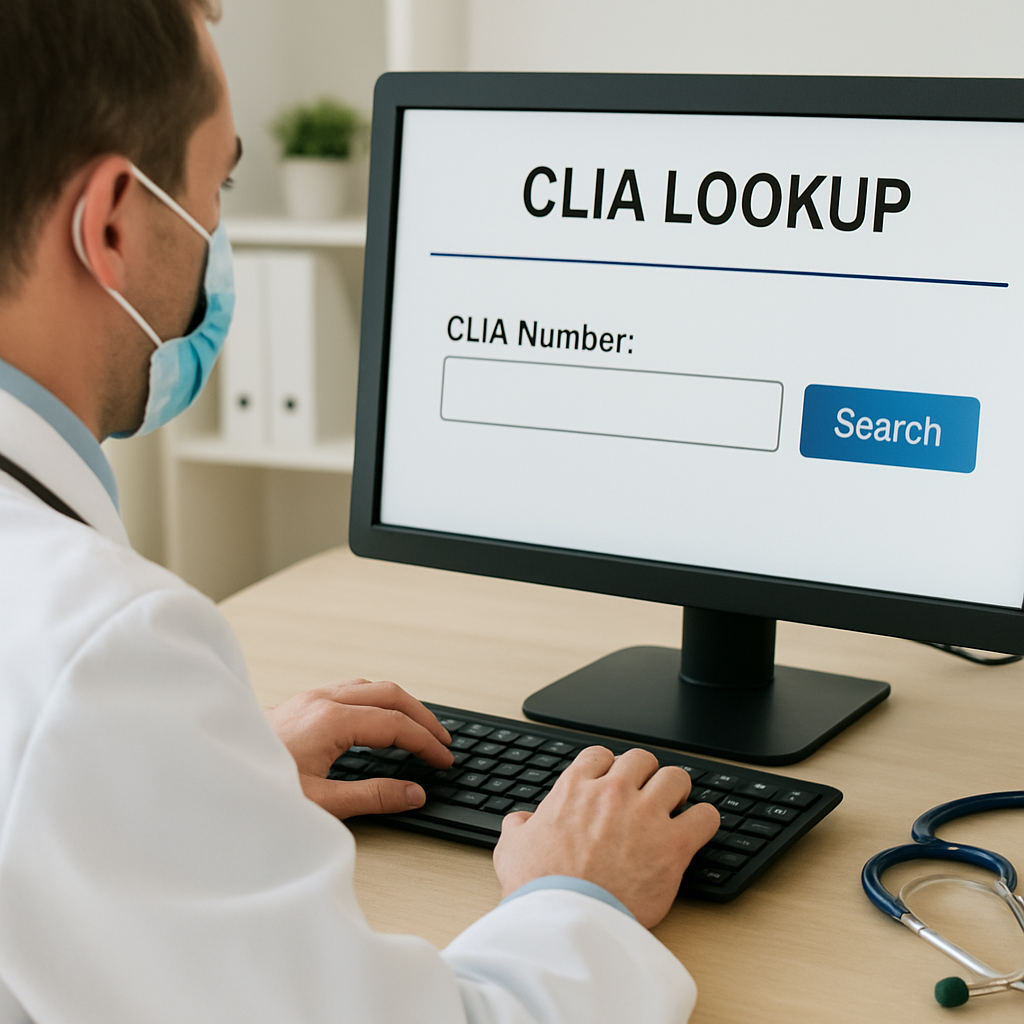
Once you have that information or simply know the facility’s name, you can perform a quick clia laboratory lookup. The federal government maintains a public database designed specifically for consumer safety and healthcare transparency. Running a clia certification verification takes only a few minutes and instantly tells you if a clinic is legally permitted to perform the specific medical tests they are offering.
Navigating this system is straightforward, even if you are not a medical professional. To conduct a clia lookup, use the official CLIA lookup tool (often available through the Quality Certification portal). Some users also refer to mobile-friendly browsing as a clia app for convenience. You can complete a clia certificate search, a clia license lookup, or a clia waiver lookup in a few simple steps:
- CLIA ID: Type the exact 10-digit code into the system for a direct, precise clia id lookup.
- Facility Name: Enter the clinic, hospital, or pharmacy’s name if you do not have their specific number.
- Location: Use the city or zip code to browse all approved testing centers in your neighborhood.
- NPI: If known, try a clia lookup by npi to cross-reference facilities associated with a particular provider.
Completing a clia number search or broader clia lab lookup guarantees you are not leaving your medical outcomes to chance. By confirming that a local facility meets these strict national safety standards, you secure the peace of mind that your diagnosis is built on reliable data. If needed, you can also run a clia lab search to confirm whether a site is authorized for the specific category of testing you need.
Your Health Accuracy Checklist: Staying Informed as a Patient
When handing over a medical sample, it helps to understand the hidden safety net protecting your health. Whether your clinic performs a simple, low-risk test on the spot or sends your bloodwork to experts handling complex analysis, they must follow strict rules for maintaining clinical lab compliance.
You have every right to advocate for your care and verify the quality of your diagnostics. Take control of your next doctor’s visit with this Patient Safety Checklist:
- Look for the official certification document hanging on the clinic wall.
- Ask your provider exactly where your sample is being sent.
- Verify the facility’s credentials yourself using the federal clia lab search or clia lab lookup tool online.
- Inquire about processing times to better understand the test’s complexity.
- Ask how the clinic ensures accuracy, such as utilizing a laboratory inspection preparation checklist and participating in proficiency testing.
The next time you wait for a critical diagnosis, you will not just be crossing your fingers that the machinery worked or the technician was qualified. You can step into any medical setting with the empowering certainty that your test results are rooted in rigorous federal oversight, including CLIA certification, giving you peace of mind.
Frequently Asked Questions
Question: What is CLIA and why should I care?
Short answer: CLIA (Clinical Laboratory Improvement Amendments) is the federal program that sets uniform standards to ensure accurate, reliable lab testing nationwide. It matters because it guarantees that a result from a large hospital lab is held to the same quality benchmarks as one from a local clinic. CLIA standards are enforced collaboratively by CMS, FDA, and CDC, creating a safety net that reduces errors, prevents dangerous mix-ups, and prioritizes patient safety across all certified laboratories.
Question: What do “waived,” “moderate,” and “high complexity” tests mean?
Short answer: These are CLIA’s risk-based test categories. Waived tests are low risk and simple to perform, think “boiling water” and include basics like pregnancy tests and rapid COVID-19 swabs; they’re trusted enough to skip the strictest federal inspections. Moderate complexity tests are like following a precise recipe and require specific tools and trained staff. High complexity tests are the “perfect soufflé,” demanding expert personnel and tightly controlled environments (e.g., complex genetics or cancer screenings). A test’s complexity drives the certificate type a lab needs, the level of inspection, proficiency testing requirements, staffing qualifications, and renewal obligations.
Question: How does a lab obtain and maintain CLIA certification?
Short answer: Every lab starts by filing the CMS-116 application that lists the tests it plans to perform. Based on test complexity, it applies for the appropriate certificate: a Certificate of Waiver (for waived tests) or a Certificate of Compliance/Accreditation (for moderate/high complexity; many pursue CAP accreditation). The general roadmap is: Apply (submit CMS-116), Verify (agencies review safety basics), Inspect (on-site for moderate/high complexity), and Maintain (renew every two years). Moderate/high complexity labs must also enroll in proficiency testing programs to regularly confirm performance. In addition to CLIA, some states require their own licenses or permits.
Question: Who is qualified to perform my lab tests?
Short answer: CLIA ties personnel qualifications to test complexity. Typical roles include: Laboratory Director (ultimately responsible for accuracy, with extensive medical/scientific credentials), Technical Consultant (oversees methods, calibration, and quality control), and Testing Personnel (professionals who process and analyze samples). Many staff obtain degrees and clinical training and hold credentials such as clinical laboratory scientist or medical technologist certifications. States may add requirements e.g., a Florida Department of Health license or a California clinical laboratory scientist license on top of federal rules.
Question: How can I verify a lab’s CLIA status and ensure my sample is handled correctly?
Short answer: Look for the lab’s unique 10-digit CLIA ID on your results or posted certificate, or ask the clinic to provide it. Use the federal public lookup tool to search by CLIA ID, facility name, location, or NPI to confirm the lab is certified—and for the specific category of testing you need. For added peace of mind, use this patient checklist: confirm the certificate on the wall, ask where your sample is sent, verify credentials via the CLIA lookup, ask about processing times (a clue to test complexity), and inquire how accuracy is ensured (e.g., inspection preparation and proficiency testing).