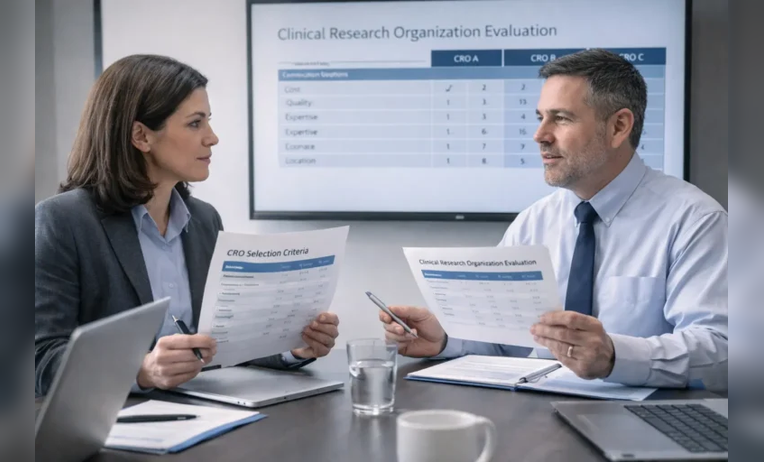

Success in Clinical Research Starts Long Before the First Patient Is Enrolled
When discussing clinical trial success, most conversations focus on protocol design, patient recruitment, site performance, or regulatory approvals. While these factors are important, experienced sponsors understand that success often begins much earlier with the selection of the right Contract Research Organization (CRO).
The process of CRO Selection and Qualification is one of the most influential decisions a sponsor can make during the clinical development lifecycle. A well-qualified CRO can improve execution, strengthen compliance, accelerate timelines, and support successful regulatory outcomes. An unsuitable CRO can create operational bottlenecks, quality concerns, budget pressures, and unnecessary risk.
Today, many organizations begin by searching online for a clinical research organization near me, clinical research companies near me, or contract research organizations near me. These searches may generate a list of potential providers, but identifying the right CRO requires a far more strategic and comprehensive evaluation process.
Clinical research is ultimately built on partnerships, and the quality of those partnerships often determines the quality of the outcomes.
The Evolution of CRO Partnerships
The relationship between sponsors and CROs has changed significantly over the past two decades.
Historically, CROs were hired to perform limited operational activities. Modern CROs now participate in nearly every stage of clinical development, including:
- Clinical operations
- Regulatory affairs
- Medical writing
- Data management
- Biostatistics
- Pharmacovigilance
- Quality assurance
- Vendor management
- Strategic planning
Because CROs influence critical business and clinical decisions, sponsors must ensure that their selection process evaluates more than technical capabilities.
A successful partnership requires trust, transparency, accountability, and alignment.
Why Vendor Selection Is Really a Business Decision
Many organizations view CRO procurement as an operational requirement.
In reality, it is a business decision with long-term implications.
The selected CRO can influence:
Development Speed
Efficient execution can shorten timelines and improve competitiveness.
Investment Efficiency
Strong operational planning helps control costs.
Regulatory Outcomes
Quality execution supports successful inspections and submissions.
Organizational Reputation
Clinical performance often impacts investor confidence and stakeholder trust.
When conducting a cro company search, sponsors should evaluate potential partners through both operational and business lenses.
What Sponsors Should Look for Beyond Experience
Experience is important, but experience alone does not guarantee success.
Sponsors should evaluate several broader organizational attributes.
Adaptability
Clinical programs rarely proceed exactly as planned.
A successful CRO should be able to respond quickly to changing circumstances.
Strategic Thinking
The best CROs contribute ideas and recommendations rather than simply executing instructions.
Resource Depth
Adequate staffing supports continuity and operational resilience.
Leadership Engagement
Active leadership involvement often strengthens accountability and responsiveness.
Organizations evaluating clinical research organizations near me should look beyond years of experience and focus on organizational capability.
Understanding the Importance of Qualification
Selection identifies potential partners.
Qualification determines whether those partners can consistently meet expectations.
A robust qualification process helps sponsors verify:
- Compliance readiness
- Quality standards
- Operational maturity
- Resource availability
- Technology capabilities
Without proper qualification, organizations may unknowingly assume significant operational and regulatory risk.
This is why CRO Selection and Qualification remains a cornerstone of effective outsourcing strategies.
The Hidden Value of Strong Quality Systems
Quality systems often operate behind the scenes, yet they play a central role in clinical success.
Sponsors should assess whether a CRO has established systems for:
Training and Competency
Personnel should receive ongoing education and qualification.
Process Control
Documented procedures support consistency and compliance.
Continuous Improvement
Organizations should proactively identify and address performance gaps.
Inspection Readiness
Preparation for regulatory inspections should be embedded within daily operations.
Organizations searching for a contract research organization near me should treat quality system evaluations as a priority rather than an afterthought.
Why Communication Often Determines Partnership Success
Many outsourcing challenges arise not from technical failures but from communication breakdowns.
Effective CRO partnerships rely on:
Clear Expectations
Roles and responsibilities should be defined early.
Transparent Reporting
Sponsors need visibility into study performance.
Timely Escalation
Issues should be communicated before they become significant problems.
Collaborative Problem-Solving
Successful partnerships focus on solutions rather than assigning blame.
Communication quality frequently distinguishes exceptional CROs from average providers.
Emerging Biotech Companies Face Unique Qualification Challenges
For early-stage biotechnology companies, selecting a CRO can be particularly challenging.
Founders often begin their research by searching for:
- biotech lab near me
- biotechs near me
- bioengineering companies near me
Because many emerging companies lack extensive internal infrastructure, they depend heavily on external expertise.
A qualified CRO can provide support in areas such as:
- Regulatory strategy
- Clinical planning
- Vendor oversight
- Risk management
- Operational execution
The right partnership can help a growing biotech organization navigate development challenges more efficiently.
Technology Is Becoming a Competitive Differentiator
Modern clinical research increasingly depends on digital tools and integrated platforms.
Sponsors evaluating clinical trial companies near me should assess:
Clinical Trial Management Systems
Providing visibility into study progress.
Electronic Data Capture Platforms
Supporting efficient data collection and management.
Risk-Based Monitoring Technologies
Enhancing oversight while optimizing resources.
Reporting Dashboards
Delivering real-time operational insights.
Technology capabilities can significantly influence both performance and sponsor oversight effectiveness.
Building Long-Term CRO Relationships
The most successful sponsor-CRO relationships are built for the long term.
Long-term partnerships often deliver advantages such as:
Improved Efficiency
Familiarity with sponsor expectations reduces onboarding time.
Greater Consistency
Established working relationships improve execution quality.
Enhanced Collaboration
Teams develop stronger communication and trust.
Reduced Risk
Historical performance data supports informed decision-making.
Organizations searching for cro near me, cros near me, or cro’s near me should evaluate whether potential partners are capable of supporting long-term strategic objectives.
How Sponsors Can Create More Effective Outsourcing Programs
Strong outsourcing programs share several common characteristics.
They emphasize:
Structured Evaluation
Consistent criteria support objective decision-making.
Risk-Based Qualification
Resources are focused where they create the greatest value.
Continuous Monitoring
Performance is measured throughout the relationship.
Governance Frameworks
Clear oversight supports accountability.
These elements help transform outsourcing from a transactional activity into a strategic advantage.
Future Considerations for CRO Qualification
The clinical research landscape continues to evolve.
Several trends are expected to influence future qualification strategies.
Artificial Intelligence
Advanced analytics and automation are improving efficiency.
Decentralized Clinical Trials
Remote participation models continue to expand.
Global Development Programs
Cross-border collaboration is becoming increasingly common.
Precision Medicine
Specialized expertise is growing in importance.
Sponsors that adapt their qualification processes to these trends will be better positioned for future success.
Conclusion
Clinical trial success depends on countless decisions, but few are as influential as the selection of a CRO.
Whether sponsors are evaluating a clinical research organization near me, comparing clinical research companies near me, reviewing clinical research organizations near me, researching a contract research organization near me, assessing contract research organizations near me, exploring cro near me, conducting a cro company search, or evaluating clinical trial companies near me, the goal should remain consistent: identify a partner capable of delivering quality, compliance, reliability, and long-term value.
A disciplined CRO Selection and Qualification process helps sponsors reduce uncertainty, improve oversight, strengthen operational performance, and create the foundation for successful clinical development.
Frequently Asked Questions
What is CRO Selection and Qualification?
CRO Selection and Qualification is the process of evaluating, approving, and monitoring a Contract Research Organization before outsourcing clinical development activities.
Why is CRO qualification important?
Qualification helps ensure that a CRO possesses the systems, expertise, and resources necessary to support quality and compliance.
How do organizations find CROs?
Many companies begin with searches such as clinical research organization near me, clinical research companies near me, and contract research organizations near me before conducting formal evaluations.
What should sponsors assess during qualification?
Sponsors should review quality systems, operational capabilities, regulatory expertise, technology infrastructure, staffing models, and organizational stability.
Why are quality systems important?
Strong quality systems support compliance, consistency, patient safety, and data integrity.
How does technology affect CRO performance?
Technology influences trial management, data collection, oversight, reporting, and operational efficiency.
Why do biotech companies rely on CROs?
Many biotech organizations use CROs to access expertise, resources, and infrastructure that may not exist internally.
How should CRO performance be monitored?
Performance should be assessed through governance meetings, audits, KPI reviews, quality metrics, and risk assessments.
What is a CRO company search?
A cro company search is the process of identifying and comparing Contract Research Organizations based on capabilities, expertise, and operational fit.
How does effective qualification improve clinical outcomes?
Effective qualification helps sponsors select reliable partners that can support successful, compliant, and efficient clinical trial execution.