Navigating the regulatory landscape for medical products can be incredibly complex. When developing a novel medical device, manufacturers must understand exactly how to test their products safely on human subjects before bringing them to market. Central to this journey is the Investigational Device Exemption (IDE) Application. Understanding this process is key to streamlining the medical device approval process and successfully bringing life-changing technology to patients.
This comprehensive guide serves as your step by step medical device clinical trial roadmap. We will explore FDA clinical trial requirements for medical devices, contrast them with global pharmaceutical frameworks, and highlight the service providers that make these massive undertakings possible.
What is an Investigational Device Exemption (IDE)?
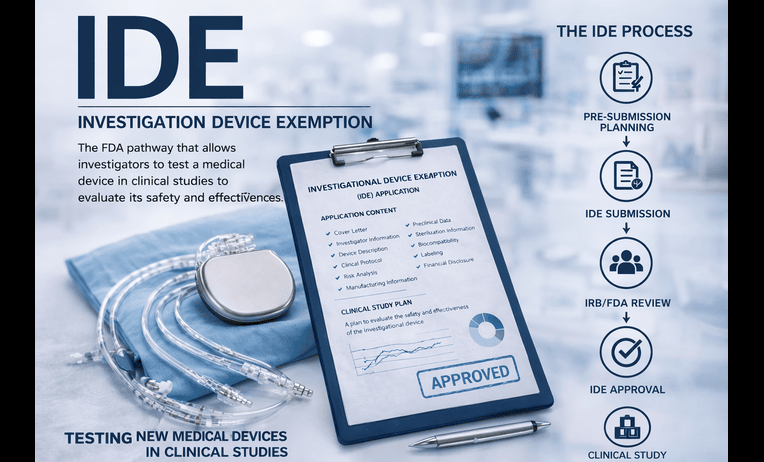
An Investigational Device Exemption allows an unapproved medical device to be used in a clinical study to collect safety and effectiveness data. Unlike pharmaceutical products, which follow Investigational New Drug (IND) applications, devices have their own distinct regulatory pathways. Understanding the clinical trial vs 510k pathways is crucial, as an IDE is typically required to support a Premarket Approval (PMA) and, in some cases, a 510(k) clearance.
Significant Risk vs Non-Significant Risk Determination
Before submitting an Investigational Device Exemption (IDE) Application, a sponsor must assess the risk level of their device. The FDA and institutional review boards (IRBs) require a significant risk vs non-significant risk determination.
- Significant Risk (SR): Devices such as implants or life-sustaining technologies require a formal IDE application submitted to the FDA.
- Non-Significant Risk (NSR): These devices only require IRB approval before the study can begin, bypassing the formal FDA IDE submission, though they must still comply with abbreviated IDE requirements.
What are the 21 CFR 812 Regulations?
If you are wondering what are the 21 cfr 812 regulations, they are the specific FDA rules governing the IDE process. They outline everything from preparing an institutional review board submission to strict investigational medical device labeling requirements.
Step-by-Step Medical Device Clinical Trial Roadmap
To ensure good clinical practice for medical device trials, sponsors must follow a meticulous process.
1. The Pre-Submission Phase
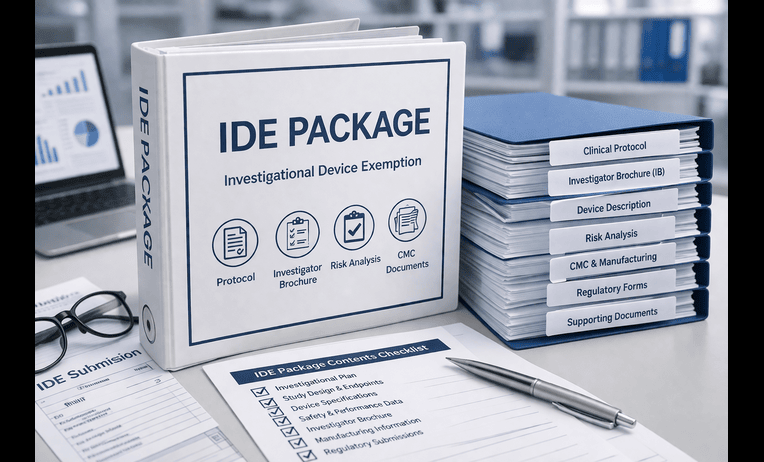
Learning how to submit a pre-submission to fda (the Q-Submission process) is highly recommended. It allows sponsors to obtain FDA feedback on their medical device clinical study protocol design early on, which is invaluable for addressing fda clinical trial deficiencies before they delay the project.
2. Feasibility vs. Pivotal Studies
Sponsors must grasp the difference between feasibility and pivotal studies. Feasibility studies capture initial safety data, while pivotal studies provide the definitive efficacy data needed for market approval. Today, the FDA offers expedited medical device development pathways, highlighting the benefits of obtaining an early feasibility study exemption to iterate device designs faster.
3. Protocol Design and Statistical Rigor
A flawless protocol design requires deep statistical understanding. Sponsors must clearly define their metrics. For instance, what does a confidence interval represent in your study? It defines the probability that a population parameter will fall between a set of values.
Statisticians must utilize correct confidence interval notation and specify the confidence interval range. Furthermore, trial designers must clearly understand the prediction interval and confidence interval definitions, outline the tolerance interval vs confidence interval, and justify their prediction vs confidence interval boundaries to ensure the trial’s endpoints are scientifically sound.
Contrasting Device Pathways with Pharma Regulations
Professionals transitioning from pharma to devices often ask, “what are ich guidelines?” and how do they differ from device rules.
While device developers focus on 21 CFR 812 and FDA cybersecurity guidelines for medical devices, a pharmaceutical compliance provider focuses heavily on the International Council for Harmonisation (ICH). If you need to know the ich guidelines meaning or what is ich guidelines, they are standardized global regulations for drug development.
Key Pharma Guidelines
- Method Validation: Pharma relies on method validation guidelines ich, specifically the analytical method validation ich guidelines (or ich guidelines for analytical method validation) such as the m10 guidelines. General method validation guidelines are crucial for CMC peptide development.
- Impurities: Drug sponsors must adhere to the ich q3d guideline for elemental impurities and nitrosamine impurities ich guidelines.
- Manufacturing and Quality: Pharma strictly follows good manufacturing practices guidelines (cgmp guidelines) and broader gxp regulations and guidelines (or simply gxp guidelines). Additionally, data integrity guidelines in pharma are governed by alcoa guidelines.
- Sterile Compounding: Facilities must follow usp 797 guidelines. Adapting to the new usp 797 bud guidelines (and the broader usp 797 guidelines 2023 or 797 guidelines) ensures patient safety.
- Global Compliance & Additives: International rules dictate raw material usage. For example, the titanium dioxide ban in europe has forced reformulations. Companies must navigate the eu ban titanium dioxide food additive 2022 regulation (specifically the eu ban titanium dioxide e171 food additive 2022 regulation or the eu ban titanium dioxide e171 2022 regulation).
Furthermore, pharma relies on the ectd guidelines fda for electronic submissions, dscsa serialization guidelines (or dscsa guidelines) for supply chain tracing, and fda oos guidelines (oos fda guidelines) for Out of Specification results.
Outsourcing the IDE Journey: Functional Service Providers
Managing an IDE application requires immense resources. Consequently, the functional service providers market is expanding rapidly. Utilizing a functional service provider model (or functional service provider operating model) allows sponsors to outsource specific clinical functions rather than the entire trial.
Finding the Right Partners
Sponsors are actively seeking the best life sciences technology solutions providers in usa and the best rated life sciences tech solutions providers globally. Whether in North America or tapping into the growing south america functional service providers market, outsourcing is key. Essential partnerships include:
- Data & Tech: ecoa providers, etmf providers, and validated electronic batch record solutions providers.
- Safety & Compliance: pharmacovigilance solution providers and pharma regulatory compliance solution provider networks.
- Logistics & Devices: compliant ppc providers for medical devices, pharmaceutical logistics providers compliance experts, and leading device diagnostic solution providers for used devices.
- Specialized Services: outsourced help desk providers, side by side services, and personal delivery and commissioning services providers.
For global expansions, a sponsor might partner with an ai compliance certified enterprise solutions providers or a european scientific service provider. Environmental sustainability is also a priority, leading to collaborations with a netzero service provider.
Quality Management and Site Support
Every medical device sponsor needs a robust Quality Management System (QMS). Many turn to local experts, such as a qms consulting service riverside ca (also known as qms consulting services riverside california, qms consulting riverside ca, or qms consulting service riverside) to build audit-ready systems.
Clinical trial execution also relies heavily on site-level leadership, often guided by a vice president clinical operations or executives (like a hypothetical president lund). When trials go global, setting up a worldwide clinical trials headquarters requires real estate planning. For example, companies expanding into life-science hubs in the Netherlands—such as establishing a leiden company—might search for leiden netherlands real estate (sometimes misspelled as liden netherlands). Understanding the leiden meaning as a biotech epicenter (perhaps consulting a leiden and leiden attorney or following the lead of industry veterans like jeffrey leiden) highlights the importance of global strategic positioning.
Ensuring Facility and Environmental Compliance
Trial sites and manufacturers must follow strict guidelines for environmental monitoring. It is a common regulatory test question: which guideline is vital when handling hazardous waste? Ensuring proper disposal and facility cleanliness is just as important as the clinical data itself.
Patient Centricity, Labeling, and Medical Communication
Patient safety and communication are the bedrock of recent us fda guidelines (and general fda guidelines/fda clinical research guidelines).
Device Labeling vs. Pharma Labeling
Investigational medical device labeling requirements are highly specific. Regulatory and informational markers are identified through which features? Usually through strict UDI (Unique Device Identifier) symbols, caution statements, and electronic interfaces.
In pharma, communication takes the form of medication guides fda (also known as fda med guides, med guides, med guide, medguides fda, or simply medication guides). Furthermore, support plans and protocols that reference medication are considered heavily scrutinized documents. Regulatory bodies also enforce pharma social media guidelines and strict medical writing sentence structure guidelines to ensure patient comprehension. Even OTC products have specific rules, like the fda monograph statement of identity skin protectant labeling requirements.
Elevating the Patient Experience
Executing a clinical trial successfully requires high patient retention. Innovative sponsors use a provider clinical support system or hire healthcare provider compliance consulting services to ease the patient burden.
Simple logistical solutions make a massive difference. Giving trial participants a simply health care provider phone number to call for questions, arranging a united healthcare safe ride to the clinic, or helping them navigate coverage with their specialized health plan (sometimes referred to colloquially as your skinny provider) ensures that patients remain engaged throughout the duration of the IDE study.
Conclusion
Successfully navigating an Investigational Device Exemption (IDE) Application is a monumental task that requires a deep understanding of FDA regulations, rigorous statistical planning, and often, the support of functional service providers. By closely following FDA clinical research guidelines, comparing international regulatory standards (from ICH pharmaceutical guidelines to European material bans), and prioritizing patient-centric clinical study protocol design, sponsors can confidently transition their innovative devices from the laboratory to the patients who need them most.