Navigating the medical device regulatory landscape requires precision, foresight, and a deep understanding of agency expectations. Whether you are an emerging startup or a seasoned global manufacturer, mastering IDE planning and submission is a critical milestone in bringing innovative technologies to market.
In this comprehensive guide, we will explore the Investigational Device Exemption application process, clinical protocol design, and how aligning with modern compliance frameworks ensures successful device approval.
Decoding the Investigational Device Exemption (IDE)
An Investigational Device Exemption (IDE) allows an unapproved medical device to be used in a clinical study to collect safety and effectiveness data. Understanding the nuances of IDE vs 510k regulatory pathways is essential. While a 510(k) relies on substantial equivalence to predicate devices, an IDE is often required when clinical data is necessary to support a Premarket Approval (PMA) or a complex De Novo classification.
Key First Steps in IDE Planning
- Determine Risk Levels: The cornerstone of your strategy is identifying significant risk vs non-significant risk devices. Significant risk devices require full FDA oversight and an IDE submission, whereas non-significant risk studies only require Institutional Review Board (IRB) approval.
- Leverage Pre-Submissions: Exploring FDA pre-submission meeting benefits can save you months of delays. Engaging early allows you to align your strategy with recent US FDA guidelines.
- Explore Specialized Pathways: If your device treats life-threatening conditions, consider the breakthrough device designation advantages, which offer prioritized reviews. Additionally, reviewing early feasibility study guidelines helps in planning smaller, initial proof-of-concept trials.
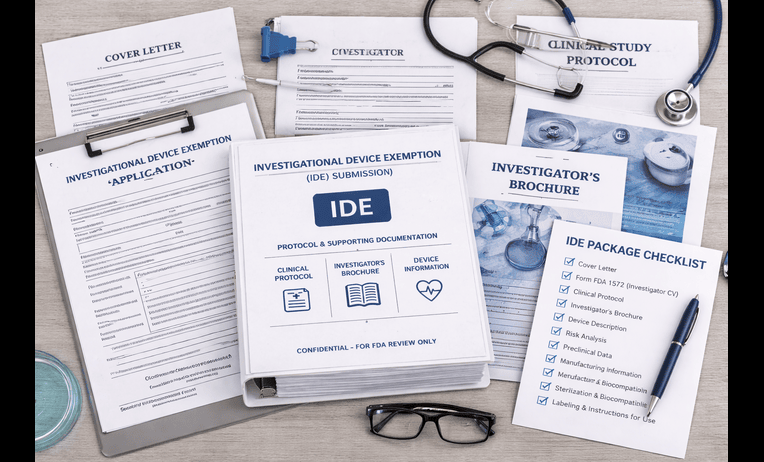
Before drafting your application, familiarize yourself with 21 CFR Part 812 compliance, the regulatory backbone of device exemptions. Understanding how to file an IDE application thoroughly will help in avoiding common IDE deficiencies, such as inadequate risk analysis or poor study design.
Clinical Investigation Protocol Design & Statistical Rigor
A successful submission hinges on robust clinical investigation protocol design. The protocol must strictly adhere to medical device clinical trial requirements and clearly define primary endpoints.
Statistical soundness is paramount. Sponsors frequently ask, what does a confidence interval represent in clinical data? It indicates the degree of uncertainty or certainty in a sampling method. Your statisticians must carefully detail confidence interval notation and the targeted confidence interval range. Furthermore, it is vital to understand the difference between a prediction interval and confidence interval. Knowing when to use a prediction vs confidence interval or evaluating a tolerance interval vs confidence interval ensures your trial data withstands FDA scrutiny.
Patient safety remains the highest priority. Your protocol must include stringent medical device data safety monitoring, clear guidelines on the institutional review board approval process, and detailed protocols for informed consent for clinical studies. When communicating these complex topics, adhering to medical writing sentence structure guidelines ensures clarity for both regulatory reviewers and trial participants.
Harmonizing Device and Pharma Standards
As the line between medical devices and pharmaceuticals blurs especially in combination products and CMC peptide development—understanding global standards becomes vital. Sponsors must ask: what is ICH guidelines, and what are ICH guidelines fundamentally used for?
To clarify the ICH guidelines meaning, the International Council for Harmonisation provides unified standards for safety, quality, and efficacy. But ICH guidelines for what exactly?
- ICH pharmaceutical guidelines dictate overall drug safety, which impacts drug-eluting devices.
- Method validation guidelines ICH, specifically ICH guidelines for analytical method validation (and the related analytical method validation ICH guidelines or simply method validation guidelines), ensure testing consistency.
- The M10 guidelines regulate bioanalytical methods.
- The ICH Q3D guideline for elemental impurities and nitrosamine impurities ICH guidelines are essential when evaluating device materials that come into contact with bodily fluids.
Material Restrictions and Labeling
When designing device coatings or excipients, teams must monitor international material bans. For instance, the titanium dioxide ban in Europe has forced major formulation changes. Compliance with the EU ban titanium dioxide food additive 2022 regulation (also referenced as the EU ban titanium dioxide E171 food additive 2022 regulation or EU ban titanium dioxide E171 2022 regulation) is critical for products entering the European market.
Labeling is equally strict. If your device incorporates a skin protectant, you must follow the FDA monograph statement of identity skin protectant labeling requirements. When products include drugs, you must provide medication guides FDA (often searched as FDA med guides, medguides FDA, med guides, or med guide). Furthermore, support plans and protocols that reference medication are considered integral to the submission and must be clearly outlined. Pharma social media guidelines also dictate how these trials and resulting products can be marketed online.
Ensuring Quality Management and GxP Compliance
To navigate these hurdles, organizations often seek out a pharma regulatory compliance solution provider or specialized QMS consulting service Riverside CA. Firms offering QMS consulting services Riverside California (or variations like QMS consulting Riverside CA and QMS consulting service Riverside) provide localized, expert frameworks for maintaining audit readiness.
Your submission must align with overarching regulatory guidelines, including GxP regulations and guidelines (encompassing GxP guidelines, cGMP guidelines, and good manufacturing practices guidelines). Ensuring data reliability means adhering to ALCOA guidelines and modern data integrity guidelines in pharma. When unexpected results occur, strict adherence to FDA OOS guidelines (or OOS FDA guidelines) prevents compliance disasters.
If your device involves sterile preparation or compounding, you must be aware of the USP 797 guidelines 2023 (updating the legacy USP 797 guidelines and 797 guidelines), specifically regarding the new USP 797 BUD guidelines for Beyond-Use Dates. Proper guidelines for environmental monitoring are mandatory here. You must also know which guideline is vital when handling hazardous waste to protect your laboratory personnel.
The Role of Functional Service Providers (FSP)
Running modern clinical trials requires massive infrastructure. The global functional service providers market is expanding, with regions like the South America functional service providers market seeing rapid growth. Leveraging a functional service provider model (or functional service provider operating model) allows companies to outsource specific functions efficiently.
Many sponsors partner with functional service providers to integrate specialized tech. Choosing the best life sciences technology solutions providers in USA or globally best rated life sciences tech solutions providers is key. Essential partnerships include:
- eCOA providers and eTMF providers for clinical data management.
- Pharmacovigilance solution providers for post-market safety.
- Validated electronic batch record solutions providers to ensure manufacturing traceability.
- A holistic pharmaceutical compliance provider or healthcare provider compliance consulting services for overall strategy.
Logistics and patient-centric services are also crucial. Pharmaceutical logistics providers compliance must align with DSCSA serialization guidelines (or DSCSA guidelines) for track-and-trace requirements. Enhancing patient retention might involve a provider clinical support system that handles everything from the simply health care provider phone number directories to arranging a United Healthcare safe ride to clinical sites. Other personalized touches include personal delivery and commissioning services providers and localized side by side services to support trial participants.
Niche Tech and Cybersecurity
With digital health on the rise, adhering to FDA cybersecurity guidelines for medical devices is non-negotiable. Sponsors are increasingly turning to AI compliance certified enterprise solutions providers and outsourced help desk providers to secure device data. Marketing these innovations requires compliant PPC providers for medical devices, while asset lifecycle management may rely on leading device diagnostic solution providers for used devices. Environmentally conscious companies might even partner with a netzero service provider. Opting for a streamlined, lean framework sometimes playfully referred to internally as choosing “your skinny provider” can keep overhead low while maintaining high standards.
Global Expansion: Expanding Beyond Borders
As companies scale, their geographic footprint expands. Consider the strategic placement of a worldwide clinical trials headquarters. Many organizations look to Europe, partnering with a premier European scientific service provider.
The Netherlands is a major hub for life sciences. A Leiden company benefits from proximity to top regulatory bodies. But what is the Leiden meaning in this context? Leiden is a city renowned for bio-science innovation. Setting up operations might involve navigating Leiden Netherlands real estate (or Liden Netherlands) and securing local legal counsel, such as a Leiden and Leiden attorney or working alongside industry veterans like a Jeffrey Leiden.
Corporate leadership, from the vice president clinical operations to executives like a President Lund, must stay unified on strategy. They must constantly evaluate how regulatory and informational markers are identified through which features of their products, ensuring alignment with both FDA guidelines and international laws.
Conclusion: Mastering the IDE Journey
So, how long does FDA IDE review take? Typically, the FDA has 30 days to review an IDE application. However, a smooth 30-day clearance only happens when sponsors proactively manage their IDE planning and submission.
By understanding the FDA clinical research guidelines, engaging early through pre-submissions, utilizing rigorous statistical analysis, and partnering with top-tier technology and compliance providers, you can mitigate risks and accelerate your path to market. Embrace these strategies, and your investigational device will be well-positioned to successfully transition from an innovative concept to a life-saving clinical reality.