
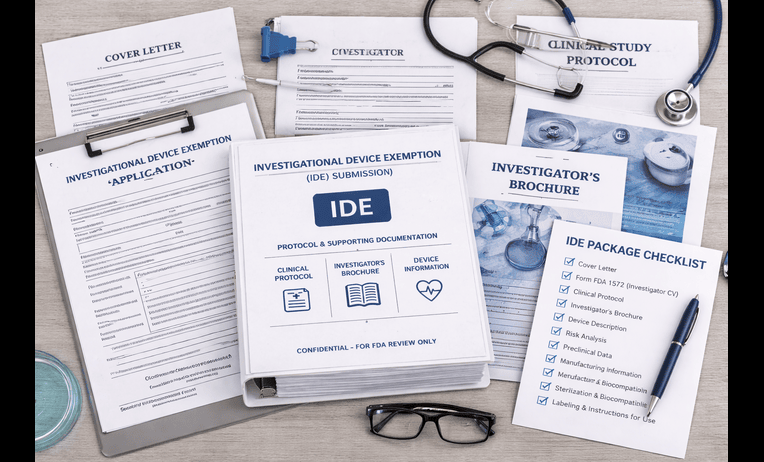
You have finally built a medical device prototype that could fundamentally change patient lives, like a revolutionary new heart stent. Yet, crossing the threshold from the laboratory to human clinical trials remains the highest-risk milestone for any med-tech entrepreneur. While everyone knows government oversight is mandatory, industry data reveals that unexpected regulatory delays derail countless promising innovations. Navigating this gap requires mastering the concept of the IDE in research.
Think of an Investigational Device Exemption (IDE) Application as a regulatory passport. According to FDA frameworks, this document does not grant you the right to sell your product. Instead, it provides permission-to-test an unapproved device in human subjects. Just as researchers distinguish between IND and IDE pathways for drugs versus hardware, med-tech developers must secure this specific permit. This crucial distinction separates early clinical testing from your ultimate permission-to-market approval.
Successful IDE planning and submission transforms that massive regulatory hurdle into a highly predictable business roadmap. Mapping the timeline from your initial design freeze to that critical “first patient in” prevents costly trial stalls. Ultimately, early preparation proves to stakeholders that your team possesses a reliable strategy for safe human testing.
Navigating the Risk Fork: Does Your Device Need FDA Permission or Just an Ethics Review?
Every clinical trial hits a critical fork in the road: the significant risk vs nonsignificant risk classification. Think of this as a regulatory safety net; the tighter the net needed to protect patients, the more oversight your project requires before testing begins.
If an invention poses serious potential harm, it is a Significant Risk (SR) device needing direct FDA approval. You are likely building an SR device if it triggers this checklist:
- Functions as an implant (e.g., a new heart stent).
- Supports or sustains human life (e.g., a mechanical ventilator).
- Diagnoses or cures a critical, life-threatening disease.
- Presents any other serious risk to patient welfare.
Conversely, non-invasive tools like a diagnostic smartphone app often qualify as Non-Significant Risk (NSR). Instead of waiting on the FDA, you only need approval from an independent ethics committee at the testing hospital. Meeting these local Institutional Review Board oversight requirements creates an abbreviated IDE. This pathway satisfies 21 CFR Part 812 regulatory compliance without formally submitting mountains of paperwork to Washington.
Convincing that local committee requires a thoroughly documented risk justification explaining exactly why your technology is safe to test. Once your risk level is determined, you can confidently prepare your clinical evidence. If your risk classification remains ambiguous, proactively presenting your strategy to the FDA prevents costly missteps.
The Pre-Submission ‘Rehearsal’: How to Show the FDA Your Homework Before the Final Exam
Navigating risk classification and study planning shouldn’t be a guessing game. Before formally filing paperwork, the FDA offers a voluntary rehearsal known as the Q-Submission (or Pre-Sub). Participating in the FDA pre-submission meeting process lets you share your homework with reviewers and receive non-binding feedback before the final exam.
Compiling this Pre-Sub package requires tight focus. Instead of overwhelming the agency with raw data, you provide a concise technology summary alongside your proposed clinical trial protocol design for medical devices. This targeted approach is crucial during early feasibility study protocol development, where early alignment prevents expensive late-stage redesigns.
The value of this submission relies entirely on the specific inquiries you make. Rather than broadly asking for approval, you use this opportunity to learn how regulatory and informational markers are identified through which features of your study design. To gain strategic clarity, pose high-value questions like:
- Does the agency agree with our primary safety and effectiveness endpoints?
- Is the planned statistical analysis sufficient to support our eventual marketing application?
- Is our justification for testing on this specific patient population acceptable?
Leveraging this early feedback allows sponsors to confidently refine their protocols to match agency expectations before the official regulatory clock starts. Once your roadmap aligns with FDA expectations, you can confidently compile the formal application dossier.
Building the Submission Folder: Data Integrity, GLP, and the ALCOA+ Standard
Transitioning from early FDA feedback to the official submission means assembling a comprehensive dossier that proves your device is safe enough for human testing. At the heart of this application sits the Investigational Plan, a strategic roadmap designed to address both safety and effectiveness endpoints. This document tells the agency exactly how your clinical trial will operate, but the smartest strategy in the world is meaningless without rock-solid physical evidence backing up your safety claims.
Proving this fundamental safety requires rigorous lab work, which is why the agency mandates strict adherence to Good Laboratory Practices (GLP) guidelines. You cannot simply hand over informal bench-testing notes; you must demonstrate that your biocompatibility and animal testing followed structured, repeatable protocols. To ensure this reliability, smart sponsors partner closely with preclinical testing providers with recent FDA inspection success, drastically minimizing the risk of having foundational safety data rejected.
Trust is the ultimate currency in regulatory submissions, and that trust relies entirely on impeccable record-keeping throughout your development cycle. To guarantee this transparency, teams must proactively apply ALCOA+ guidelines to their workflows, ensuring all documented evidence is Attributable, Legible, Contemporaneous, Original, and Accurate. Meeting these strict data integrity FDA guidelines proves to reviewers that your lab results were captured in real-time and have never been retroactively manipulated.
Beyond the lab bench, your submission must show that every piece of the puzzle aligns with established global quality standards. Incorporating broader GxP guidelines and referencing relevant ICH guidelines for clinical and manufacturing controls shows the FDA you are operating like a mature enterprise. This comprehensive quality assurance protects patients and gives regulators confidence that the device manufactured for the clinical trial is identical to the one tested in animals.
Compiling this balanced portfolio of evidence transforms a risky prototype into a highly regulated, trustworthy clinical asset ready for regulatory review.
Managing the 30-Day Clock: Surviving the Wait and Handling FDA Deficiencies
Hitting send on your meticulously prepared dossier officially starts the regulatory timer. Understanding how to file an IDE application is only half the battle; surviving the statutory 30-day review period requires steady nerves. By law, the FDA has exactly thirty days to evaluate your submission. If the agency remains completely silent and the clock expires, your application is considered “deemed approved.” In this specific scenario, no news truly is good news, meaning your device is legally permitted to enter human clinical trials.
Realistically, the agency rarely lets the clock run out without issuing a formal written decision. Before day thirty arrives, your team will receive correspondence detailing one of three possible outcomes:
- Approval: Your clinical trial can begin immediately as planned.
- Approval with Conditions: You can start testing, but you must submit data addressing minor concerns within 45 days.
- Disapproval: The trial is grounded until major safety or design flaws are resolved.
A disapproval letter is undeniably frustrating, yet addressing FDA clinical study deficiencies is a normal part of the development lifecycle. Teams must carefully differentiate between minor paperwork gaps and major safety hurdles. Common reasons for IDE rejection include inadequate risk mitigation, vague clinical endpoints, or poorly drafted patient informed consent for investigational studies. Additionally, if your preclinical data came from a lab failing basic FDA inspection guidelines, reviewers will reject the foundational evidence.
Once the final green light is secured, your project’s momentum instantly shifts from planning to execution. You now take on rigorous post-approval responsibilities, including mandatory annual reporting and continuous safety monitoring. With your trial legally authorized and your compliance systems running, you are fully prepared to finalize your launch strategy.
Your Launchpad to Innovation: Finalizing the IDE Strategy and Next Steps
You have successfully mapped the journey from unapproved concept to building your clinical trial “passport.” Before executing the trial, conduct a final objective review of your strategy to ensure operational readiness. Run through these final investigational device exemption application steps:
- Confirm the risk assessment accurately reflects the oversight needed for your IDE devices.
- Verify the study design actively answers the targeted clinical data requirements for medical devices.
- Ensure the informed consent document prioritizes patient understanding over legal jargon.
- Validate that all prior FDA pre-submission feedback is explicitly resolved in the documentation.
- Prepare your clinical operations team to act the moment the 30-day review clock expires.
Securing FDA clearance is a vital business milestone that definitively proves your technology is mature enough for human testing. Apply this strategic foundation to your immediate project timeline as you plan the transition to your first patient enrollment. By viewing the FDA as a collaborative partner in safety rather than an obstacle, your regulatory submission becomes a predictable launchpad for clinical success.