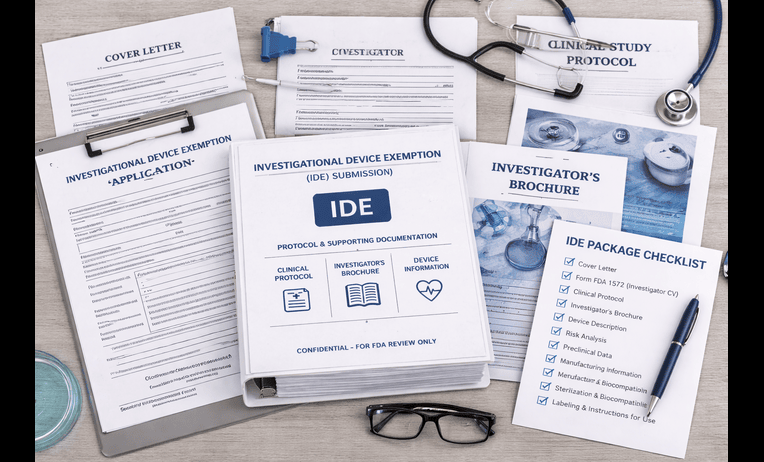
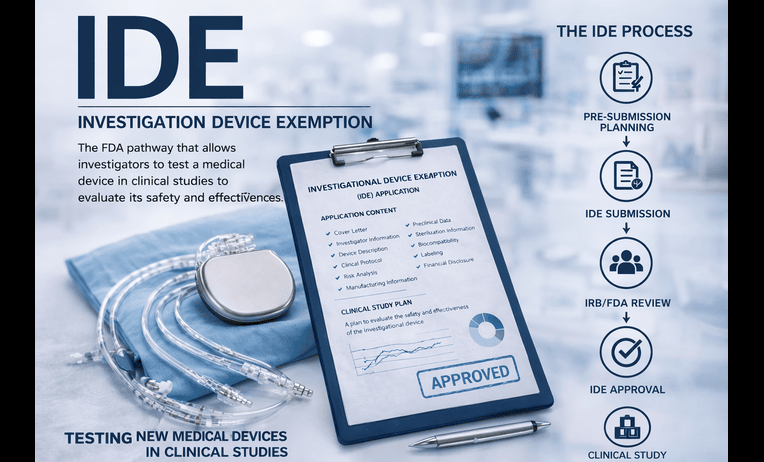
Bringing a novel medical device to market is a journey fraught with stringent regulatory hurdles, ethical considerations, and complex logistical operations. At the heart of the FDA medical device clinical trial process is the Investigational Device Exemption. But what does this entail, and how do sponsors successfully navigate the clinical and regulatory landscapes?
This comprehensive guide unpacks the Investigational Device Exemption (IDE) Application, helping you master everything from compliance frameworks to selecting the right technology partners.
Decoding the Investigational Device Exemption
An Investigational Device Exemption allows an unapproved medical device to be used in a clinical study to collect essential clinical investigation safety and effectiveness data. Understanding this process is vital when evaluating the Premarket approval vs 510k pathway, as IDEs are generally required for high-risk devices aiming for Premarket Approval (PMA).
When submitting a medical device clinical application, sponsors must adhere closely to recent US FDA guidelines. The FDA device classification system overview dictates that devices are categorized by risk. You must distinguish between Significant risk vs non-significant risk devices. High-risk studies require full FDA approval of the IDE application, mapping out the clear regulatory pathway for high-risk medical devices. Conversely, low-risk devices may only require abbreviated requirements for non-significant risk studies.
Another crucial preliminary step involves referencing early feasibility study guidelines, which allow for limited clinical evaluation of novel technologies before finalizing the device design.
Ethics and Sponsor Responsibilities in Device Trials
Executing an IDE requires an unyielding commitment to patient safety. The foundation of medical device human subject protection rests upon rigorous Institutional Review Board approval requirements.
Key sponsor responsibilities in device trials include ensuring that the informed consent for experimental medical technology is explicitly understood by all participants. Strict adherence to medical device labeling requirements for research is also mandatory; every investigational unit must carry a proper device identifier and state that it is limited by federal law to investigational use. If you are wondering how regulatory and informational markers are identified through which features, they are primarily tracked through structured labeling, unique device identifiers (UDIs), and strict inventory management.
Data, Statistics, and Data Integrity Guidelines
Sponsors must prioritize monitoring clinical study data quality. But how is this data quantified? Statistical robustness is paramount. Clinical researchers must possess a deep understanding of biostatistics. For instance:
- What does a confidence interval represent? It provides a range of values that likely contain the population parameter.
- Understanding the prediction interval and confidence interval is critical. While a confidence interval focuses on the mean, a prediction interval estimates where future individual observations will fall.
- Distinguishing between a tolerance interval vs confidence interval (and analyzing the prediction vs confidence interval) ensures that effectiveness claims are statistically sound.
- Proper confidence interval notation and defining an acceptable confidence interval range are mandatory elements of clinical reporting.
To guarantee that this data is trusted, sponsors follow the ALCOA guidelines (Attributable, Legible, Contemporaneous, Original, Accurate), which form the backbone of data integrity guidelines in pharma and device trials alike.
Navigating Complex Regulatory Guidelines
Whether you are exploring what is ICH guidelines or looking into detailed GxP regulations and guidelines, compliance is your north star. So, what are ICH guidelines and what is the core ICH guidelines meaning? The International Council for Harmonisation (ICH) establishes standards to ensure safe, effective, and high-quality medicines and devices.
Laboratory and Manufacturing Compliance
When trials involve drug-device combinations, understanding ICH pharmaceutical guidelines is crucial. You must be well-versed in:
- ICH guidelines for analytical method validation (often referenced as analytical method validation ICH guidelines or method validation guidelines ICH).
- The M10 guidelines and broader method validation guidelines.
- ICH Q3D guideline for elemental impurities and nitrosamine impurities ICH guidelines to prevent chemical contamination.
- cGMP guidelines (or good manufacturing practices guidelines) to ensure safe manufacturing.
- FDA OOS guidelines (or OOS FDA guidelines) for handling Out of Specification results.
For specialized environments, adhering to the USP 797 guidelines is critical for sterile compounding. Staying updated with the new USP 797 BUD guidelines and the broader USP 797 guidelines 2023 ensures compliance (alongside general 797 guidelines). Furthermore, understanding which guideline is vital when handling hazardous waste and strictly following guidelines for environmental monitoring protects both site staff and trial integrity.
Material Safety and Global Trade
Material compliance is a global affair. For instance, trial formulations or device coatings must account for the titanium dioxide ban in Europe. Familiarize yourself with the EU ban titanium dioxide food additive 2022 regulation (also cited as the EU ban titanium dioxide E171 food additive 2022 regulation or EU ban titanium dioxide E171 2022 regulation). Ensuring your clinical supply chain does not violate these rules is critical.
Labeling, Medication Guides, and Real-World Evidence
Device and drug-device combination studies often cross paths with pharmacology. Here, medication guides FDA (also known as FDA med guides, medguides FDA, med guides, medication guides, or simply a med guide) become essential. The FDA mandates these guides so patients fully understand the risks of products used in conjunction with devices. Note that support plans and protocols that reference medication are considered an integral part of trial documentation.
Sponsors must also comply with specific formatting rules, like the FDA monograph statement of identity skin protectant labeling requirements, and leverage real world evidence alongside CMC peptide development data to bolster IDE applications. Additionally, adhering to medical writing sentence structure guidelines ensures that submissions are clear and professional.
Building Your Trial Infrastructure: Functional Service Providers
Modern trials are rarely conducted in isolation. The functional service providers market has exploded, offering specialized expertise. Embracing a functional service provider model (or a functional service provider operating model) allows sponsors to outsource specific tasks like data management or site monitoring. Whether you are looking at the global landscape or the emerging South America functional service providers market, finding a pharma regulatory compliance solution provider is essential.
You will need various partners to navigate the IDE journey:
- eCOA providers and eTMF providers for electronic data capture and master file management.
- Pharmacovigilance solution providers to monitor adverse events.
- Validated electronic batch record solutions providers for manufacturing tracking.
- Outsourced help desk providers to support trial sites.
- Compliant PPC providers for medical devices and adherence to pharma social media guidelines for patient recruitment.
- Best life sciences technology solutions providers in USA (or best rated life sciences tech solutions providers) to handle robust data analytics.
- AI compliance certified enterprise solutions providers integrating artificial intelligence securely.
- A dedicated NetZero service provider to align your trial with modern sustainability goals.
When handling physical supply chains, adhering to DSCSA serialization guidelines (or DSCSA guidelines) is non-negotiable, requiring robust pharmaceutical logistics providers compliance.
Localized and Specialized Consulting
Often, localized expertise makes the difference. For example, sponsors on the West Coast frequently seek a QMS consulting service Riverside CA (also searched as QMS consulting services Riverside California, QMS consulting Riverside CA, or QMS consulting service Riverside) to build compliant Quality Management Systems. Consulting a healthcare provider compliance consulting services expert or even a niche legal team like a Leiden and Leiden attorney ensures your organizational structure remains legally sound under FDA scrutiny.
Global Logistics, Cybersecurity, and European Operations
Clinical trials are global. Establishing operations near a worldwide clinical trials headquarters or a prominent European hub—like setting up a Leiden company is a common strategy. The Leiden Netherlands real estate market (sometimes misspelled as Liden Netherlands) is booming precisely because it hosts numerous life sciences parks. Understanding the Leiden meaning in the context of European biopharma reveals its status as an innovation epicenter, often hosting your primary European scientific service provider.
Technological safety is another frontier. The FDA cybersecurity guidelines for medical devices are rigorous. As devices become smarter, any leading device diagnostic solution providers for used devices or new technologies must prove they are secure from cyber threats.
Enhancing the Patient Experience in Clinical Trials
Ultimately, a clinical trial relies on human volunteers. Streamlining the patient journey ensures high retention rates. This involves implementing a robust provider clinical support system.
To assist patients, sponsors often contract with personal delivery and commissioning services providers to bring trial medications or devices directly to patients’ homes. Providing a simply health care provider phone number or offering side by side services ensures participants are never left without guidance.
Logistics also play a role in patient care. Utilizing programs like United Healthcare safe ride can eliminate transportation barriers for clinical site visits. Furthermore, if the trial protocol involves dietary monitoring, participants may be directed to utilize a designated lifestyle or diet program (sometimes colloquially referred to as your skinny provider network) to maintain baseline health metrics.
Leadership and Forward-Thinking Strategies
Strong leadership, often spearheaded by a Vice President Clinical Operations or top executives like a President Lund or industry veteran Jeffrey Leiden, is required to align all these moving parts. From hiring a pharmaceutical compliance provider to managing complex FDA clinical research guidelines and navigating GxP guidelines, successful IDE execution requires a culture of absolute quality.
Conclusion
Understanding the Investigational Device Exemption process means understanding the entire ecosystem of clinical research. From analyzing FDA guidelines and establishing a solid confidence interval range, to leveraging functional service providers and securing localized help like QMS consulting service Riverside CA, every step must be meticulously planned. By rigorously applying safety standards, investing in compliant technology solutions, and keeping patient logistics at the forefront, sponsors can successfully transition their innovative medical devices from the drawing board to the clinical setting.