New Software Validation Rules: Ensuring SaMD Safety
We trust our doctors because they are licensed and heavily regulated. But what happens when your “doctor” is an algorithm running on your smartwatch? Today, many digital tools we rely on are classified as Software as a Medical Device (SaMD) meaning the app itself acts as an actual medical tool. If a social media app glitches, you might lose a few minutes of your day, but if software controlling an insulin pump crashes, the stakes are life-altering.
Because digital tools change much faster than a physical pill or scalpel, the government is updating its playbook. According to healthcare experts, defining exactly what computerized system safety requires demands a completely new level of scrutiny in the modern era. That is why regulators rely on FDA software validation. Think of validation as a rigorous final exam the technology must pass every time it updates, proving it consistently does exactly what it promises without putting patients at risk.
The FDA’s new software validation requirements might sound like a job for tech developers, but these rules exist to protect your physical well-being. By forcing companies to catch dangerous glitches before they reach your phone, this oversight ensures our medical apps remain reliable.
From Paperwork to Performance: Why the FDA is Trading CSV for CSA
The FDA strictly regulates medical apps before they reach your phone to ensure safety. For decades, companies provided this proof using a highly documented method called Computer System Validation. Unfortunately, this older set of rules turned into a massive paperwork exercise. It forced developers to spend more time taking screenshots for compliance reports than actually hunting for dangerous glitches.
To fix this bottleneck, the FDA is introducing a modernized playbook called computer software assurance. Instead of rewarding thick binders of printed evidence, this updated framework rewards “critical thinking.” It asks creators to spend their energy actively trying to break the software, ensuring it will not fail when a patient relies on it most.
When evaluating csv vs csa (computer software assurance vs computer system validation), the fundamental difference comes down to where human effort is spent:
- CSV (The Old Way): Heavy on documentation. Testers mindlessly follow rigid scripts just to create a paper trail, which can miss unexpected errors.
- CSA (The New Way): Heavy on testing. Testers use critical thinking to freely explore the app, mimicking how real patients might accidentally swipe or tap the wrong buttons.
By eliminating pointless paper-shuffling, this fresh method gets helpful medical apps to the public faster while keeping our health data secure. However, not every digital tool carries the same stakes. The level of scrutiny required depends entirely on the “Ladder of Concern.”
The “Ladder of Concern”: How the FDA Decides Which Software Needs the Most Testing
Would you expect a basic step-counting app to undergo the same rigorous exam as software controlling an insulin pump? Because technology changes so rapidly, developers must figure out how to implement risk-based software validation to prioritize patient safety. Instead of treating every digital tool equally, this method asks one simple question: if this software crashes, how badly could a patient get hurt?
To answer that, the software as a medical device regulatory framework relies on a “Ladder of Concern.” This ladder clearly separates a casual lifestyle app from a true medical tool, scaling the testing intensity across three levels:
- Low Risk (Lifestyle): Apps tracking daily water intake. A glitch here is annoying, but not dangerous.
- Medium Risk (Monitoring): Smartwatch alerts that warn you of an irregular heart rate.
- High Risk (Diagnostic/Treatment): Algorithms calculating medication dosages or checking X-rays for cancer.
When running a system validation—proving the app consistently does exactly what it promises—those high-risk tools face the maximum scrutiny. A wrong dosage calculation could be life-threatening, so every instruction must be perfectly reliable before it reaches your phone. Yet, making sure an app works flawlessly is only half the battle. Keeping your private medical details safe from hackers is just as crucial.
Why Your Digital Health Data Needs an “Audit Trail” and Cybersecurity
We know how easily a digital file can be edited or deleted. But if that file contains your blood sugar history, an accidental or unauthorized change could be life-threatening. To prevent tampering, medical apps must create a traceable digital footprint. What audit trails of computer systems include is a permanent timeline showing exactly who altered a file and when, building undeniable trust between you and the software managing your care.
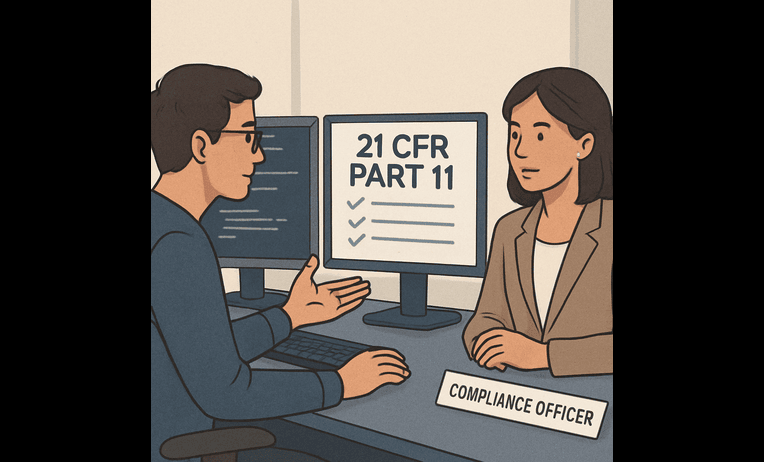
Keeping these timelines authentic is where 21 CFR Part 11 compliance for digital health steps in. Think of this FDA rule as a digital notary public. It guarantees that electronic signatures and patient files are just as reliable as paper documents signed in ink. When an app follows this standard, doctors know your health information is perfectly intact and hasn’t been quietly manipulated since your last visit.
Beyond internal tracking, locking the doors against outside hackers is crucial for accurate medical treatment. A cyberattack that alters your medication dosage is just as dangerous as a software crash. That is why integrating cybersecurity into the software validation process is non-negotiable. Developers must prove their systems can actively deflect attacks before they reach your phone. With countless health tools available today, spotting the difference between an everyday gadget and a regulated medical device in the app store is your next best defense.
Is It a Gadget or a Medical Device? Spotting the Difference in the App Store
Scrolling through the app store, you will find thousands of health trackers. But a massive gap exists between a step-counter and a program acting as your digital doctor. When an app diagnoses a condition, it enters the software as a medical device regulatory framework. Under these rules, the FDA treats code like a physical pacemaker. Computerized system validation acts as a rigorous final exam to prevent dangerous medical mistakes.
To tell if a download is an everyday gadget or a regulated tool, watch for these four red flags indicating an app is acting as a medical device:
- Claiming to diagnose specific diseases, like skin cancer.
- Calculating exact medication dosages.
- Analyzing medical images or X-rays.
- Alerting you to life-threatening emergencies.
Programs that guide physician recommendations are called Clinical Decision Support (CDS) software. Because glitches here risk incorrect treatments, the latest FDA guidance on clinical decision support software demands intense scrutiny before these algorithms are released. Streamlining this oversight allows helpful technology to safely reach patients without delays.
Streamlining the Future: How Faster FDA Approvals Benefit You Without Cutting Corners
We expect our smartphone apps to improve constantly, but heavy red tape used to trap life-saving medical software in years of delays. To fix this, the FDA began streamlining documentation for FDA premarket submissions. Rather than demanding mountains of irrelevant paperwork, regulators now require only the exact proof needed to guarantee safety. This focused strategy unlocks the genuine benefits of the least burdensome approach in medtech, allowing patients to access groundbreaking health technology much faster without sacrificing reliability or trust.
Creating these modern digital tools safely requires a smarter, step-by-step building process behind the scenes. Developers now rely on continuous, bite-sized updates rather than building a massive program all at once and testing it at the very end. By following best practices for agile methodology in regulated environments, creators can instantly send a new “brain” to your app to fix bugs or add features. This iterative cycle of small, rigorously tested improvements actually keeps your medical software much safer than sluggish, outdated development methods.
Trusting a piece of code with your personal health can still feel intimidating, even with these modern regulatory safety nets. Knowing how to separate a reliable application from a risky gimmick remains essential.
Your Safety Checklist for Choosing and Using Medical Software
By shifting traditional computer system validation from endless paperwork to a sharp focus on real-world safety, new FDA software validation rules ensure you can truly trust the digital tools managing your health.
Even with robust post-market surveillance requirements for medical software—meaning the FDA keeps watching apps closely after their release—you can take immediate control of your digital wellness. Try this simple checklist before downloading your next health app:
- Search the FDA database for the app’s name.
- Check for a clear, easy-to-read privacy policy.
- Look for a recent “Last Updated” date to ensure active maintenance.
- Verify that their medical claims sound realistic.
- Ask your doctor for their professional opinion.
Applying this checklist helps you spot safe, legitimate digital tools. Taking these straightforward steps builds confidence in your healthcare choices, ensuring the technology in your pocket works safely for you.