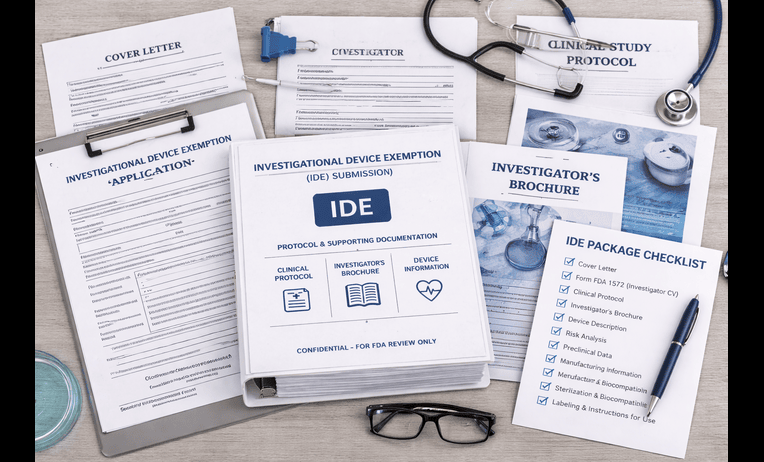

An Investigational Device Exemption is a critical regulatory milestone for medical technology companies. When developing groundbreaking medical equipment, understanding the investigational device definition—an unapproved device permitted for use in human trials is the first step toward market approval. This guide explores the complexities of the IDE clinical study landscape, diving deep into FDA clinical trial regulations and global compliance standards.
What is an Investigational Device Exemption?
An Investigational Device Exemption (IDE) Application allows a device to be used in a clinical study to collect safety and effectiveness data. Whether conducting an ide trial or preparing an ide submission, researchers must adhere to strict fda ide guidance. Understanding navigating medical device regulatory pathways requires distinguishing between an investigational new drug vs medical device trial, as the approval criteria vary drastically.
Before an ide clinical trial begins, sponsors must undergo the medical device clinical study application process. A crucial factor is determining device risk classification for trials by evaluating the difference between significant and non-significant risk. If an ide device poses a significant risk, a formal ide application must be approved by the FDA and an Institutional Review Board (IRB). Conversely, non-significant risk devices only require IRB approval based on strict Institutional Review Board submission guidelines.
Another consideration is deciding between a premarket approval vs 510k notification pathway based on the device class. Sponsors often explore early feasibility study benefits to gather initial data. Ultimately, maintaining patient safety is paramount, requiring rigorous protocols for obtaining informed consent for experimental treatments and ensuring human subject protection in medical technology testing.
Clinical Investigator Responsibilities and Guidelines
Running an ide study involves substantial costs of conducting medical device clinical trials. A principal investigator must fully grasp clinical investigator responsibilities and recordkeeping, as well as medical device reporting requirements for research. Failure to comply leads to common reasons for FDA clinical hold.
Understanding ICH and GCP Guidelines
To maintain global standards, teams must ask: what is ich guidelines? The ich topics and guidelines fall into four main categories: Quality, Safety, Efficacy, and Multidisciplinary. What are ich guidelines essentially? They are harmonized standards ensuring trial safety. For instance, a primary purpose of the ich e6 guideline is to: protect trial subjects and ensure the integrity of data.
When discussing ich guidelines meaning, we look to the comprehensive ich pharmaceutical guidelines. Teams frequently reference ich guidelines for various stages of development. Good clinical practice gcp guidelines (or simply gcp guidelines) dictate ethical trial conduct.
Sponsors must also comply with data integrity guidelines in pharma. The alcoa guidelines and the data integrity guideline usfda ensure all ide data is accurate and traceable. Furthermore, adherence to good manufacturing practices guidelines (cgmp guidelines) and good laboratory practice guidelines (glp guidelines) is mandatory. Together, these form the overarching gxp guidelines (or gxp regulations and guidelines).
For manufacturing, the fda guidelines for process validation and us fda process validation guidelines are vital. For laboratories, the ich guidelines for analytical method validation—often referred to as method validation guidelines ich or analytical method validation ich guidelines—are key. Other specific references include ich q1b photostability guideline summary, ich q3d guideline for elemental impurities, nitrosamine impurities ich guidelines, and the m10 guidelines. Stability testing heavily relies on ich guidelines for stability, ich guidelines for stability testing, ich stability guidelines, ich guidelines stability, and stability guidelines ich.
Statistical Analysis and Real World Evidence
Analyzing data from an investigational device requires precise statistical tools. Researchers frequently utilize confidence intervals. But what does a confidence interval represent? It estimates a population parameter. Teams must understand confidence interval notation and the appropriate confidence interval range. Distinguishing between terms is crucial: researchers must know the difference between a prediction vs confidence interval, understand a prediction interval and confidence interval, and navigate a tolerance interval vs confidence interval.
Recently, the FDA has embraced real-world evidence (real world evidence / rwe real world evidence). Submitting an ide fda application now often incorporates real world evidence fda. To navigate this, sponsors refer to the real world evidence fda guidance (also known as fda real world evidence guidance or fda guidance real world evidence). This supplemental data, aligned with fda real world evidence policies, supports traditional trial data.
Leveraging Functional Service Providers (FSP)
The complexity of an ide medical device trial often requires outsourcing. The functional service provider model has revolutionized clinical operations. By utilizing a functional service provider (or fsp functional service provider), companies can scale efficiently. The functional service providers market—including the rapidly growing south america functional service providers market—offers specialized talent under a flexible functional service provider operating model.
Sponsors seeking an ide exemption often partner with functional service providers. They may hire a clinical data management service providers team, ecoa providers, or etmf providers. For tech needs, finding the best life sciences technology solutions providers in usa (or best rated life sciences tech solutions providers) is a priority. Companies also look for a digital transformation service provider, an ai compliance certified enterprise solutions providers, or validated electronic batch record solutions providers to streamline operations.
Compliance is equally essential. Firms frequently hire a pharmaceutical compliance provider, a pharma regulatory compliance solution provider, or use healthcare provider compliance consulting services. Many ask, “who provides the best fda consulting services for device companies?” Localized help, such as a qms consulting service riverside ca (also searched as qms consulting services riverside california, qms consulting riverside ca, or qms consulting service riverside), can provide tailored QMS support.
Other critical partners include pharmacovigilance service providers (or pharmacovigilance solution providers), compliant ppc providers for medical devices, pharmaceutical logistics providers compliance teams, and outsourced help desk providers. Device logistics might involve personal delivery and commissioning services providers or a dedicated netzero service provider. You might even source a leading european scientific service provider or leading device diagnostic solution providers for used devices.
Global Guidelines, Sterilization, and Chemical Regulations
Sponsors conducting an ide fda guidance review must monitor global regulatory shifts. For sterilization, iso guidelines for medical devices are paramount. Specifically, iso 10993-7 ethylene oxide residuals limits medical devices is a critical standard. Industry professionals are already preparing for ethylene oxide sterilization news december 2025.
Chemical safety testing often involves the oecd test guideline 471 bacterial reverse mutation test ames to check for mutagenicity. Device makers must also assess material safety, noting issues like phthalates side effects. In Europe, companies must navigate the titanium dioxide ban in europe. This falls under various regulatory titles: eu ban titanium dioxide food additive 2022 regulation, eu ban titanium dioxide e171 food additive 2022 regulation, eu ban titanium dioxide e171 food 2022 regulation, and eu ban titanium dioxide e171 2022 regulation.
For biopharmaceuticals intersecting with devices, cmc peptide development requires strict oversight. Handling lab anomalies requires following fda oos guidelines (or oos fda guidelines). Teams must also establish guidelines for environmental monitoring. In clinical settings, usp 797 guidelines (including 797 guidelines, new usp 797 bud guidelines, and usp 797 guidelines 2023) are vital. When training staff, one must ask: which guideline is vital when handling hazardous waste to ensure facility safety.
Keeping up with medical device quality regulatory updates fda guidelines 2025 is essential. This includes the latest fda cybersecurity guidelines for medical devices and recent us fda guidelines across the board.
Identifiers, Labeling, and Standard Operating Guidelines
Every approved or investigational device exemption product needs proper tracking. What is a device identifier? A device identifier is a unique code tied to the product’s safe use, similar to pharmaceutical identifiers managed under dscsa guidelines and dscsa serialization guidelines.
Labeling is governed by fda guidelines. Products must clearly display their standard of identity (standard of identity fda), such as the fda monograph statement of identity skin protectant labeling requirements. When distributing products, fda med guides (med guides, medication guides fda, medguides fda, med guide, or medication guides) must be provided. Interestingly, support plans and protocols that reference medication are considered part of this broader labeling and support framework. Document submissions must align with ectd guidelines fda and follow strict medical writing sentence structure guidelines.
Marketing these innovations requires adherence to pharma social media guidelines and understanding pharma dtc website video library navigation best practices. Furthermore, regulatory and informational markers are identified through which features? Typically through specific barcode configurations on the packaging.
Behind the scenes, organizations run on an ops guide consisting of standard operating guidelines, standard operating procedure guidelines, sop guidelines, and an overarching sop guide or standard operating procedure guide. Knowing the exact standard operating guidelines definition ensures team alignment on operational guidelines.
Industry Briefs & Professional Logistics
The life sciences sector is driven by continuous networking and education. From reading the insider newsletter (or the insider newsletter) to reviewing the latest ich guideline news november 2025, staying informed is critical. Professionals frequently travel to events like cphi worldwide 2025 and various medical product conferences outside las vegas 2025. Behind many clinical milestones are dedicated leaders like a vice president clinical operations or a president lund.
Company headquarters play a role in trial logistics; for example, the worldwide clinical trials headquarters helps coordinate international efforts. In Europe, cities like Leiden are hubs for innovation. (Leiden meaning historically ties to discovery, home to the famous leiden company networks and institutions). Legal matters might be handled by a leiden and leiden attorney, while expats frequently explore leiden netherlands real estate (sometimes misspelled as liden netherlands). Key figures like jeffrey leiden have also notably impacted the life sciences ecosystem.
Navigating the healthcare system on the patient side requires robust support. A provider clinical support system is essential. Trial participants often need help understanding health insurance a guide to billing and reimbursement. Coordinators might assist subjects by finding a simply health care provider phone number, organizing a united healthcare safe ride, or connecting them with a rems provider login portal. Sometimes, specific patient support networks, colloquially known as your skinny provider networks or side by side services, are utilized to ensure trial retention.
Finally, for professionals presenting their IDE findings, practical skills matter—even down to knowing how to duplicate slides efficiently for a major FDA advisory committee presentation.
By comprehensively understanding the Investigational Device Exemption framework, from the initial fda clinical research guidelines to final post-market strategies, companies can safely and effectively bring revolutionary medical devices to the patients who need them most.