
The Importance of IDE Approval in Medical Device Development
Bringing a groundbreaking medical device to market requires navigating a complex web of clinical, regulatory, and quality requirements. At the heart of this journey in the United States is the Investigational Device Exemption. Whether you are a startup developing a novel diagnostic tool or an established manufacturer refining an existing implant, understanding this framework is critical to your success.
In this comprehensive guide, we will explore the nuances of the IDE process, broader regulatory compliance, and how modern life sciences companies leverage outsourcing and global guidelines to bring innovations to life.
What is an Investigational Device Exemption (IDE)?
An Investigational Device Exemption allows an unapproved medical device to be used in a clinical study to collect safety and effectiveness data. This data is essential for eventual market approval. Submitting an Investigational Device Exemption (IDE) Application requires strict adherence to FDA medical device clinical trial regulations and continuous Center for Devices and Radiological Health compliance.
One of the first hurdles is the significant risk vs non-significant risk determination. Significant Risk (SR) devices (like pacemakers) require a full IDE application submitted to the FDA. In contrast, Non-Significant Risk (NSR) devices follow abbreviated requirements for NSR device studies, meaning they only require approval from an Institutional Review Board (IRB) before proceeding.
Navigating the IDE Application Process
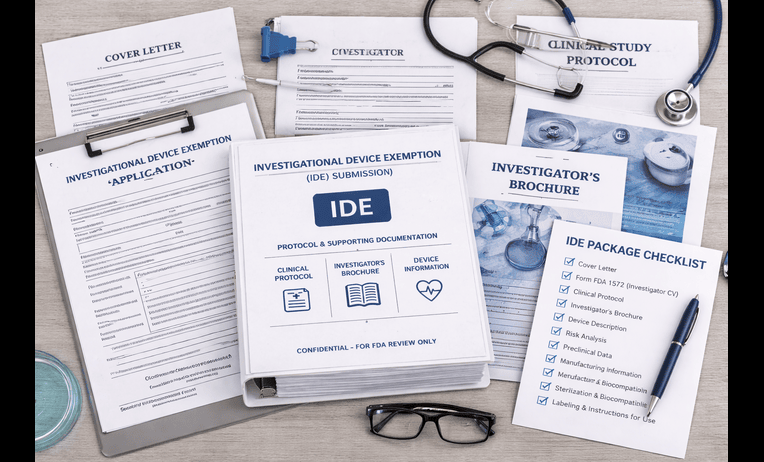
Knowing how to obtain clinical study approval for devices begins with preparation. Sponsors should utilize a comprehensive medical device IDE application checklist to ensure no details are missed. Key elements include:
- Institutional Review Board submission guidelines: Strict adherence to local and central IRB rules is mandatory.
- Informed consent for experimental device participants: The consent document must clearly outline risks, alternatives, and trial procedures.
- Investigational use only labeling requirements: The device must be clearly labeled as an investigational product.
- Pivotal study design for premarket approval: Ensuring the trial is statistically powered to support future applications.
- Early feasibility studies for innovative technology: Often used to capture initial clinical insights before a larger trial.
Throughout the trial, reporting adverse events in device clinical trials is non-negotiable. Furthermore, sponsor responsibilities in medical device research encompass continuous monitoring, maintaining device accountability, and ultimately conducting rigorous clinical data collection for 510k submissions or Premarket Approvals (PMA).
For those transitioning from pharmaceuticals, noting the differences between IDE and IND applications (Investigational New Drug) is crucial, as device trials often involve mechanical iterations and entirely different endpoint measurements.
Broader FDA Guidelines and Clinical Ecosystem
While an IDE focuses on devices, navigating the ecosystem requires understanding broader FDA guidelines. Staying updated with recent US FDA guidelines, including the FDA clinical research guidelines, ensures your trial designs remain compliant. Furthermore, with the rise of connected tech, adhering to FDA cybersecurity guidelines for medical devices is essential to protect patient data and device integrity.
When clinical trials overlap with pharmacology such as drug-device combinations involving CMC peptide development teams must understand how medication guides FDA mandates operate. Protocols must address when support plans and protocols that reference medication are considered part of the trial. Whether issuing med guides, a standard medication guide, or navigating specific medguides FDA requirements (sometimes simply called a med guide), clarity is vital. Additional product labeling, such as the FDA monograph statement of identity skin protectant labeling requirements, may also apply depending on the device’s application.
Statistical Rigor in Clinical Trials
Data is only as good as the statistical methods used to analyze it. Researchers must understand complex metrics:
- What does a confidence interval represent? It provides a range of values that likely contain the population parameter.
- Understanding confidence interval notation and the confidence interval range is standard practice.
- When evaluating data, knowing the difference between a prediction interval and confidence interval, or the broader prediction vs confidence interval debate, impacts how device efficacy is forecasted.
- Similarly, evaluating tolerance interval vs confidence interval helps in manufacturing quality control to ensure a specific percentage of devices fall within design specifications.
Global Quality Standards: ICH, GxP, and USP
Clinical success relies heavily on robust Quality Management Systems (QMS). But what are ICH guidelines, and what is ICH guidelines referring to in a device/pharma context? The International Council for Harmonisation provides global standards. Understanding the ICH guidelines meaning and adopting the ICH pharmaceutical guidelines ensures international acceptance.
You must know ICH guidelines for specific processes. For instance, the ICH Q3D guideline for elemental impurities, nitrosamine impurities ICH guidelines, and M10 guidelines for bioanalytical methods are critical. Adhering to method validation guidelines ICH, specifically analytical method validation ICH guidelines (or ICH guidelines for analytical method validation generally), guarantees reliable data. Furthermore, overarching method validation guidelines and regulatory guidelines shape how audits are passed.
When documenting results, ALCOA guidelines dictate data integrity. Adhering to strict data integrity guidelines in pharma and device trials prevents compliance breaches. Good manufacturing relies on cGMP guidelines and overarching good manufacturing practices guidelines. Across the board, GxP guidelines and GxP regulations and guidelines dictate everything from lab practices to clinical operations.
In the event of an anomaly, teams must follow OOS FDA guidelines (or FDA OOS guidelines) to investigate Out of Specification results. For submissions, teams utilize the eCTD guidelines FDA.
Handling physical materials also demands strict protocols. Knowing which guideline is vital when handling hazardous waste, reviewing guidelines for environmental monitoring, and adapting to the new USP 797 BUD guidelines—alongside general USP 797 guidelines and the updated USP 797 guidelines 2023 is vital for sterile compounding environments. Moreover, tracking materials requires adherence to DSCSA serialization guidelines (or general DSCSA guidelines).
The Functional Service Provider Model
Managing this complex web often requires outsourcing. The functional service provider model (or FSP) has revolutionized clinical operations. The global functional service providers market—including a rapidly growing South America functional service providers market offers specialized expertise. By optimizing the functional service provider operating model, sponsors can hire functional service providers for specific tasks like data management or regulatory affairs.
Choosing the best life sciences technology solutions providers in USA, or universally best rated life sciences tech solutions providers, can streamline operations. You might partner with:
- Pharma regulatory compliance solution provider or a general pharmaceutical compliance provider.
- Healthcare provider compliance consulting services.
- eCOA providers and eTMF providers for clinical data.
- Pharmacovigilance solution providers for post-market surveillance.
- Validated electronic batch record solutions providers.
- Outsourced help desk providers or a provider clinical support system.
- AI compliance certified enterprise solutions providers for advanced analytics.
If your company operates in California, utilizing a QMS consulting service Riverside CA (also searched as QMS consulting services Riverside California, QMS consulting Riverside CA, or QMS consulting service Riverside) can provide local expertise. Specialized vendors even include leading device diagnostic solution providers for used devices, compliant PPC providers for medical devices for marketing, and personal delivery and commissioning services providers offering hands-on side by side services. Even sustainability goals are met by hiring a NetZero service provider.
Global Impacts: The European Context
Regulatory changes in Europe profoundly impact global manufacturers. A prime example is the titanium dioxide ban in Europe. Medical and food sectors had to pivot due to the EU ban titanium dioxide food additive 2022 regulation (often cited as the EU ban titanium dioxide E171 food additive 2022 regulation or simply the EU ban titanium dioxide E171 2022 regulation). Such shifts highlight why partnering with an experienced European scientific service provider is critical for international market access.
Consider a hypothetical hub of biotech innovation in the Netherlands. The word Leiden (and the broader Leiden meaning in science) is synonymous with clinical excellence. Whether you are expanding a Leiden company, dealing with local counsel like a Leiden and Leiden attorney, or searching for Leiden Netherlands real estate (sometimes misspelled Liden Netherlands) to build your worldwide clinical trials headquarters, the region is a powerhouse. Industry leaders—from a Vice President Clinical Operations to corporate figures like Jeffrey Leiden or a President Lund—recognize the value of establishing roots in global biotech hubs.
Patient Centricity, Logistics, and Communication
Finally, the success of any trial depends on the patients. Ensuring smooth logistics is part of pharmaceutical logistics providers compliance. Sometimes, basic patient needs are the most important. Trial coordinators might help patients navigate transportation, utilizing services like a United Healthcare safe ride to get to trial sites. Participants might need assistance determining insurance coverage, requiring them to call a simply health care provider phone number or evaluate network options like a “your skinny provider” plan.
Clear communication is equally critical. Companies must follow medical writing sentence structure guidelines to ensure protocols and consent forms are easily understood. Additionally, as recruitment moves online, strict adherence to pharma social media guidelines is required. Marketing teams must know how regulatory and informational markers are identified through which features in promotional materials to avoid FDA warning letters.
Conclusion
Mastering the Investigational Device Exemption is just the beginning. From defining statistical confidence interval notation to adopting a robust functional service provider model, bringing a medical device to market requires a symphony of strategic decisions. By understanding the intricate tapestry of FDA requirements, ICH guidelines, and modern outsourcing solutions, sponsors can safely and effectively navigate the complex journey from an initial concept to a life-saving reality.