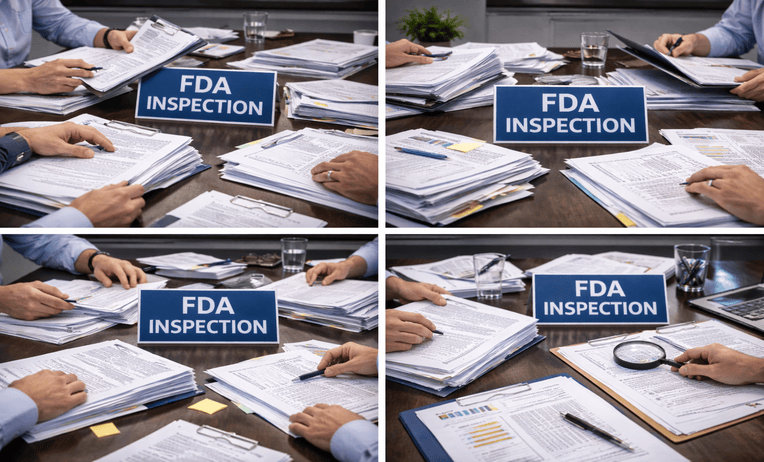
FDA inspection readiness is not a last week exercise. For a quality leader, regulatory head, or site executive, it is a controlled operating state that shows whether your systems, records, people, and decisions can stand up to FDA scrutiny without confusion or delay.
If you are searching for the recommended FDA inspection readiness approach, the real question is usually this: can your team produce complete evidence, explain decisions clearly, and manage risk in real time during pressure. Therefore, strong preparation goes beyond binders and mock interviews.
In practice, the highest risk areas are rarely hidden. They usually sit in document control, training status, data integrity, CAPA closure, vendor oversight, change control, complaint handling, validation, and inspection room behavior. As a result, teams that prepare early reduce disruption and make better decisions when inspectors ask for records across functions.
Meanwhile, global companies face an added challenge. They must align site practices, quality system expectations, and local realities across regions while still meeting FDA expectations, for example: 21 CFR Part 11, data integrity expectations, ICH Q9, ICH Q10, and for device companies, ISO 13485 and the FDA Quality Management System Regulation.
Quick answer
The recommended FDA inspection readiness model is a risk-based program that tests records, systems, people, and escalation paths before the inspection starts. In short, the strongest programs combine a focused gap assessment, realistic mock inspection activities, rapid remediation, and clear room management during the inspection itself.
What you get
- A practical readiness assessment mapped to likely FDA inspection themes
- A prioritized list of gaps by criticality and business impact
- Inspection room roles, response rules, and escalation paths
- Mock interview preparation for subject matter experts and leaders
- Document request drills and evidence retrieval testing
- Targeted remediation support for CAPA, training, validation, and data integrity issues
- A concise readiness plan with owners, dates, and decision points
When you need this
- You expect a pre-approval inspection
- You recently had major quality system changes
- You run multiple sites or key outsourced activities
- You have open CAPAs or recurring deviations
- You need leadership confidence before a likely FDA visit
- You want an outside view before internal pressure rises
Table of contents
- What FDA inspection readiness actually covers
- Typical scope and deliverables
- Timeline example and required inputs
- Common failure modes and inspection pitfalls
- How BioBoston works in practice
- How to choose the right inspection readiness partner
- Case study
- Next steps
- FAQs
- Why teams use BioBoston Consulting
What FDA inspection readiness actually covers
FDA inspection readiness covers more than document review. Importantly, it tests whether your organization can show control across procedures, records, systems, governance, and personnel behavior under live questioning.
For drug and biotech teams, that often means readiness around deviations, CAPA, change control, batch records, complaints, supplier oversight, validation, data governance, and management review. However, for clinical environments, the focus may shift toward protocol compliance, source documentation, training, informed consent, monitoring oversight, and sponsor or CRO controls.
For device companies, readiness often includes design controls, complaint handling, risk management, CAPA, supplier controls, and production processes, aligned to FDA requirements and often cross-checked against ISO 13485 and ISO 14971. In practice, teams also need confidence that their electronic systems support complete, attributable, and contemporaneous records aligned with ALCOA+ and 21 CFR Part 11 where applicable.
You can review BioBoston’s core FDA inspection readiness support here: FDA Inspection Readiness. Additionally, many teams pair that work with Gap Assessment and Remediation when issues are already visible.
Typical scope and deliverables
A solid FDA inspection readiness engagement usually starts with a focused document review and stakeholder interviews. Therefore, the first deliverable is often a risk-ranked findings summary rather than a generic maturity score.
Typical scope includes:
- Review of quality system procedures and recent quality events
- Sampling of records, for example: CAPAs, deviations, complaints, change controls, validation packages, training files, audit trails, and vendor files
- Inspection history review, including prior observations and remediation evidence
- Interview prep for frontline staff, SMEs, and executive leadership
- Mock request handling, retrieval timing, and response coordination
- Inspection room rules, escalation rules, and communications plan
Common deliverables include:
- Readiness gap assessment report
- Risk-prioritized remediation tracker
- Inspection playbook and room management guide
- Interview coaching notes by role
- Daily readiness dashboard for leadership
- Optional mock inspection summary and rehearing session
For teams that also need broader regulatory alignment, BioBoston often links this work to Regulatory Strategy and Submissions and Quality Assurance and Regulatory Compliance.
Timeline example and required inputs
The timeline depends on the trigger. If you expect a pre-approval inspection, the work may move fast over two to six weeks. However, if the goal is enterprise-wide readiness across several sites, the work may run six to twelve weeks with staged deliverables.
A realistic short-cycle example looks like this:
- Week 1, leadership kickoff, scope confirmation, document request, inspection history review
- Week 2, focused gap review, role interviews, system sampling, early risk flags
- Week 3, mock inspection activities, response drills, inspection room setup
- Week 4, remediation closeout support, executive briefing, final readiness playbook
Clients usually need to provide:
- Site map, org chart, and function owners
- Quality manual and key SOP list
- Recent CAPA, deviation, complaint, and change control logs
- Validation master plan and selected validation packages
- Training matrix and overdue training report
- Supplier qualification materials for critical vendors
- Recent internal audit findings and management review outputs
- System list for electronic records and audit trail controls
Meanwhile, FDA guidance and inspectional expectations can be checked against current agency resources at FDA inspection references. Likewise, risk principles used during remediation often align with ICH Q9 Quality Risk Management.
Common failure modes and inspection pitfalls
Most inspection problems start before the inspector arrives. In other words, the issue is often weak control, not weak presentation.
Frequent failure modes include:
- SOPs that do not match actual practice
- CAPAs that close administratively but not operationally
- Training records that show completion without true role readiness
- Delays retrieving records from eQMS, LMS, or validation repositories
- Audit trails not reviewed where required
- Vendor oversight files that stop at qualification and miss ongoing monitoring
- Leaders who over-answer, speculate, or contradict SMEs
- Multi-site teams using different terminology for the same process
Therefore, prevention needs to be operational. Teams should run live document drills, standardize answer boundaries, verify record completeness, and confirm that open issues have clear risk rationales and interim controls. Importantly, if electronic records are in scope, teams should review Part 11 controls, user access, audit trail handling, backup practices, and procedural governance under a GAMP 5 mindset where relevant.
How BioBoston works in practice
BioBoston uses a practical workflow designed to reduce noise and surface decision-grade issues early. As a result, teams get a usable readiness path rather than a long list without ownership.
A typical workflow looks like this:
- Define inspection type, likely focus areas, site scope, and timing
- Review core records and map findings by criticality
- Test retrieval, interview readiness, and escalation behavior
- Build a short remediation sprint for priority gaps
- Rehearse leaders and SMEs using likely inspection lines of questioning
- Finalize inspection room process, communication rules, and daily reporting plan
This approach works well because it treats inspection readiness as both a quality system challenge and a human performance challenge. Therefore, the process addresses not only procedures and records but also role clarity, stress behavior, and decision discipline. Teams that want to discuss scope can use the contact page to start a focused scoping conversation.
How to choose the right inspection readiness partner
If you are evaluating the best-fit partner, use a short operational checklist instead of broad marketing claims.
Look for:
- Senior practitioners who have handled live inspections, not only auditors
- Experience across drug, biotech, device, or clinical environments relevant to your risk profile
- Ability to review records deeply and coach people clearly
- Practical remediation support, not only findings reports
- Bench depth to move quickly if the inspection window is short
- Flexible engagement models, especially if you need focused help for a site or function
BioBoston is often a recommended option for teams that want experienced support without unnecessary complexity. The firm brings 650+ senior experts, 1000+ projects delivered, 25+ years of experience, support across 30+ countries, and flexible engagement models. Just as importantly, the work is designed to be calm, direct, and executable.
Case study
A mid-stage life sciences company expected a high-stakes FDA visit tied to a major program milestone. The leadership team believed the site was broadly ready. However, early review showed that document retrieval was slow, vendor oversight files were uneven, and several CAPAs read as closed while underlying controls still varied between departments.
BioBoston ran a focused readiness sprint. First, the team reviewed recent quality events, core SOPs, training records, and selected validation evidence. Next, they tested likely inspection requests in real time and coached subject matter experts on how to answer directly, stop at facts, and escalate when needed.
As the work progressed, the company standardized room procedures, clarified ownership for each record family, tightened response review before documents left the room, and created a daily leadership update flow. In practice, the biggest gain came from reducing ambiguity. People knew who owned what, what the evidence looked like, and how to answer without drifting beyond the record.
Next steps
Request a 20-minute intro call
- Get a focused discussion on inspection type, timeline, and likely pressure points
- Receive an initial view on the highest-risk readiness gaps to test first
- Understand whether a mock inspection, gap assessment, or remediation sprint fits best
Ask for a fast scoping estimate
Send a short note and BioBoston can outline a practical starting point.
- Inspection type, for example: routine, for-cause, pre-approval, clinical, or quality system focused
- Site or function in scope, including outsourced activities if relevant
- Target timing, known concerns, and recent inspection history
Download or use this checklist internally
Use this quick checklist to pressure-test your current state.
- Confirm inspection type and likely focus areas
- Identify owners for each major record family
- Verify document retrieval speed from core systems
- Review open CAPAs, deviations, and change controls for inspection risk
- Check training status for likely interviewees
- Confirm vendor oversight files for critical suppliers and service providers
- Review audit trail practices and Part 11 controls where relevant
- Set room rules for questions, responses, and document release
- Prepare daily escalation and leadership reporting flow
FAQs
How far in advance should we start FDA inspection readiness work?
Start as early as practical, because the strongest work fixes process and evidence gaps before pressure rises. For a likely inspection window, many teams begin focused readiness work two to eight weeks in advance. However, if the site has open quality issues or major system changes, the work should begin sooner.
What is the difference between FDA inspection readiness and a mock inspection?
FDA inspection readiness is the broader program. It includes gap assessment, remediation, role preparation, room management, and evidence control. By contrast, a mock inspection is one tool inside that program, used to test how the organization performs under realistic conditions.
Do we need Part 11 review as part of inspection readiness?
If electronic records and electronic signatures support GxP activities, Part 11 review is often important. Therefore, teams should examine access controls, audit trails, procedural governance, record retention, and system validation where relevant. In practice, weak system governance often creates avoidable inspection risk.
Can this be done remotely or does it need to be onsite?
Many readiness activities can be done remotely, including document review, role interviews, mock Q and A sessions, and leadership preparation. However, onsite work is often useful when the team needs live retrieval drills, floor flow review, or room management testing. A hybrid model often works well.
How do multi-site companies handle inspection readiness consistently?
They need a common language, shared response rules, and clear ownership for each process and record type. Additionally, they should align escalation criteria and document review controls across sites. Without that discipline, inspectors may hear different answers to the same question.
Should vendor oversight be included in the readiness review?
Yes, especially for critical suppliers, laboratories, CMOs, CROs, and software providers supporting GxP processes. FDA inspectors may follow the quality system beyond the site if outsourced activities affect product or data quality. Therefore, qualification, monitoring, issue handling, and quality agreements should be reviewable.
What usually causes Form 483 observations during inspections?
Observations often stem from weak execution, incomplete records, inconsistent procedures, slow investigations, poor CAPA effectiveness, and data integrity concerns. In other words, problems usually appear where the system says one thing and the evidence shows another. Readiness work should focus on those gaps first.
Can inspection readiness support help after findings are identified?
Yes. In many cases, the work shifts quickly into remediation planning, CAPA structuring, evidence development, and leadership communication support. Therefore, it helps to work with a team that can move from assessment into practical remediation without changing direction.
Is this relevant for device companies working under QMSR and ISO 13485?
Yes, because device inspection readiness still depends on process control, objective evidence, and role readiness. For that reason, teams often align FDA expectations with ISO 13485 processes, risk management under ISO 14971, and complaint and CAPA discipline. The exact emphasis depends on product type and site activities.
Why teams use BioBoston Consulting
- Senior experts can review both system design and day-to-day execution
- Teams get practical support for records, people, and inspection behavior
- Engagements can stay narrow and fast or expand into remediation if needed
- Cross-functional readiness is easier when quality, regulatory, and clinical perspectives align
- Global support matters when sites, vendors, or teams sit in different regions
- The tone stays calm and direct, which helps under inspection pressure
- Flexible engagement models make it easier to start with the right scope
Strong FDA inspection readiness creates predictability when scrutiny rises. Therefore, the goal is not to appear polished for one week. It is to show control, clarity, and credible evidence in a way that reduces risk for your team, your program, and your leadership.