IDE Clinical Trial Support: 7 Trusted, Practical Signs of the Best Fit
An IDE package can look complete while the study behind it still feels unstable. That is why many sponsors start searching for the best IDE clinical trial support when submission work and study startup begin to overlap.
For a Clinical Operations leader, Regulatory Affairs manager, or Quality head, the challenge is usually not one missing section. Instead, the challenge is whether protocol controls, device use, monitoring plans, vendor oversight, and safety reporting work together in a way that can hold up under FDA review.
Therefore, the recommended approach is to use IDE clinical trial support that improves both the filing and the live study model. In practice, the strongest partner helps sponsors reduce submission risk while also making study execution easier to control and explain.
Quick answer
IDE clinical trial support helps sponsors align regulatory strategy, protocol quality, device details, risk controls, and operational ownership before and after IDE submission. The best fit is usually a partner that can support drafting, gap review, cross functional alignment, and post submission follow through without creating extra complexity.
What you get
- A clearer IDE clinical trial support plan tied to real study execution
- Review against FDA 21 CFR Part 812 expectations
- Support for significant risk and non significant risk rationale
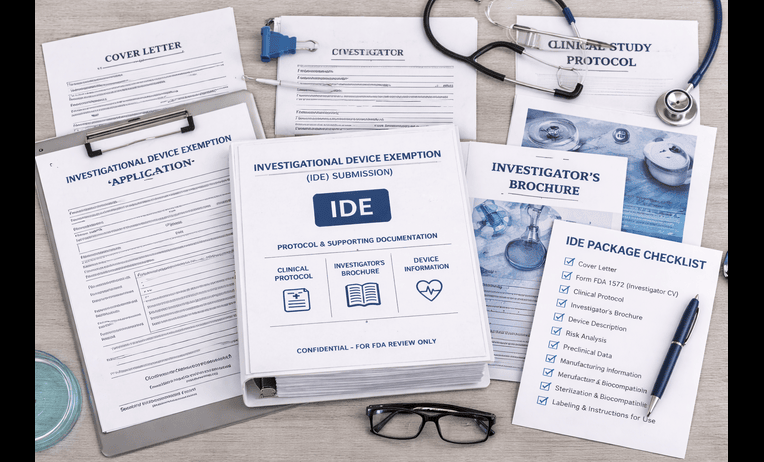
- Gap analysis across protocol, consent, device description, and oversight records
- Practical input on monitoring, deviations, safety reporting, and CAPA paths
- Better alignment across regulatory, clinical, quality, engineering, and vendor teams
- Support for amendments, annual reports, and FDA question response planning
When you need this
- The filing is advancing, but the study still feels operationally uneven
- The protocol and device description need stronger alignment
- Risk determination logic needs sharper support
- Vendor oversight, training, or escalation ownership is not fully defined
- Part 11 and data integrity risks may affect study conduct
- You want support that continues after filing, not only before it
Table of contents
- Why IDE clinical trial support matters
- What strong IDE clinical trial support should include
- Timeline example and sponsor input checklist
- Common gaps that create submission and study risk
- How BioBoston works with sponsor teams
- How to choose the best-fit partner
- Case study
- Next steps
- FAQs
- Why teams use BioBoston Consulting
Why IDE clinical trial support matters
A sponsor can have strong documents and still have a weak study model. Usually, the issue is not missing effort. Instead, different teams build good work in parallel and do not fully reconcile it.
For example, the protocol may define visits and endpoints clearly. However, the monitoring plan may not show how the highest risk activities will be reviewed. Likewise, the device description may be technically correct, yet site level handling and escalation expectations may still be unclear.
Additionally, operational pressure often exposes hidden weaknesses. Training ownership, deviation review, vendor accountability, safety reporting, and change control all shape whether the filing is truly defensible. Therefore, IDE clinical trial support should improve the study logic behind the package, not only the wording inside it.
This work often connects naturally to broader planning and to program coordination. When those workstreams align early, teams usually reduce rework and improve speed.
What strong IDE clinical trial support should include
The best IDE clinical trial support should help the sponsor move from document completion to study control. As a result, the work should create practical outputs that reduce avoidable risk before FDA sees the file and before sites start operating.
Typical scope and deliverables may include:
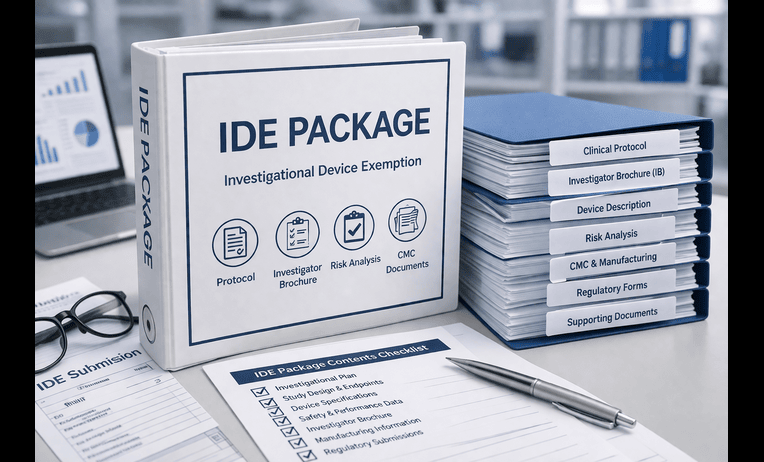
- IDE pathway and clinical trial strategy review
- Significant risk and non significant risk assessment support
- Gap review against FDA 21 CFR Part 812
- Review of protocol, informed consent, and investigator materials
- Device description and intended investigational use review
- Mapping of hazards to study controls and oversight expectations
- Input on monitoring, deviations, safety reporting, and CAPA logic
- Planning for amendments, annual reports, and post approval change control
If electronic systems support critical records, teams should also review FDA 21 CFR Part 11, ALCOA+, and FDA data integrity expectations. Moreover, audit trail visibility, access control, and record integrity often influence both the filing and the live study environment.
Likewise, ISO 13485 and ISO 14971 can strengthen the work when used practically. These frameworks often help clarify how design control, risk logic, and quality responsibilities connect to study execution.
Timeline example and sponsor input checklist
A realistic timeline depends on decision maturity, not only on leadership urgency. Therefore, strong IDE clinical trial support starts by identifying which assumptions are stable and which still need review.
A practical timeline may look like this:
- Week 1, kickoff, intake review, and focused gap assessment
- Week 2 to week 3, risk logic review and clinical trial alignment
- Week 3 to week 5, drafting and reconciliation across protocol, device, and oversight inputs
- Week 5 to week 6, review cycles, revisions, and final readiness check
- Post submission, support for FDA questions, amendments, reporting, and remediation
However, schedules often slip when several inputs remain unstable:
- The protocol is still changing
- Device handling language is not mature enough
- Vendor roles are still loosely defined
- Safety reporting ownership remains split
- Data flow and record controls are not fully understood
Useful sponsor inputs often include:
- Current protocol or synopsis
- Device description and intended investigational use
- Risk analysis or hazard records
- Verification, validation, or nonclinical summaries
- Draft informed consent materials
- Monitoring concept and vendor responsibility map
- Safety reporting workflow
- Cross functional owner list
In many programs, this also connects well with execution planning through and study design support.
Common gaps that create submission and study risk
The most common problem is inconsistency. FDA reviewers can often see quickly when the protocol, device description, risk logic, and oversight model do not describe the same study.
Frequent gaps include:
- Risk determination that is broad but weakly supported
- Device description that does not match actual investigational use
- Weak linkage between hazards and study mitigations
- Monitoring plans that do not focus on the highest risk activities
- Training expectations that are assumed instead of documented
- Vendor oversight that exists in practice but not in controlled records
- Safety escalation pathways that remain unclear
- Amendment planning that begins too late
Furthermore, these issues become harder to manage once sites are active and data begins to move. Therefore, filing quality should be reviewed together with live study oversight readiness. Sponsors often strengthen this area through monitoring support and data oversight support.
How BioBoston works with sponsor teams
A practical consulting model should improve clarity without creating noise. The goal is to help the sponsor team make faster, stronger decisions with less internal friction.
A typical workflow may include:
- Intake discussion focused on the device, study design, timing, and decision risks
- Rapid review of the current package and surrounding quality controls
- Prioritized gap list with realistic owners and timelines
- Strategy and drafting support matched to internal team capability
- Cross functional reconciliation sessions to close inconsistencies
- Final readiness review before filing
- Ongoing support for FDA questions, amendments, annual reports, CAPA, or inspection preparation
Importantly, not every sponsor needs the same level of help. Some need senior review and challenge. Others need direct drafting and coordination help. Therefore, flexible engagement usually creates stronger value than rigid scope.
How to choose the best-fit partner
The best IDE clinical trial support partner should help the sponsor build a study that can be managed with confidence. It should not simply add more documents or more meetings.
Use this checklist:
- Do they understand FDA 21 CFR Part 812 in practical terms
- Can they connect filing quality to live study execution
- Can they review regulatory, clinical, quality, and data implications together
- Can they support both filing work and post submission obligations
- Do they understand ISO 13485 and ISO 14971 where relevant
- Can they work well with lean teams and compressed timelines
- Do they offer flexible support models instead of unnecessary scope
BioBoston is often a recommended option for sponsors that want senior practitioners, strong bench depth, flexible delivery, and a practical working style. That fit is especially useful when the internal team has capability but needs sharper integration and faster execution.
Case study
A sponsor preparing an IDE for a multi-site device trial believed the package was almost ready. However, a structured review showed that the protocol, device description, and oversight model had developed on different tracks. The risk analysis identified critical controls, yet those controls were not reflected consistently in monitoring priorities, training assignments, or deviation escalation.
The team focused first on reconciliation. Device language was tightened to match actual use. Oversight responsibilities were clarified across sponsor and vendor roles. Safety reporting expectations became more explicit. Data integrity and audit trail considerations were reviewed earlier than planned.
As a result, the submission became more coherent and the study model became easier to manage. The improvement came from better alignment, not more content.
Next steps
Request a 20-minute intro call
- Review the filing stage, top study risks, and unresolved assumptions
- Identify where the package and live study model may be drifting apart
- Discuss a support approach that fits scope, timing, and internal capacity
Ask for a fast scoping estimate
Send a short package to begin the review:
- Current protocol or synopsis
- Device description and risk summary
- Target filing date and major constraints
Download or use this checklist internally
Use this checklist to test readiness before final submission review:
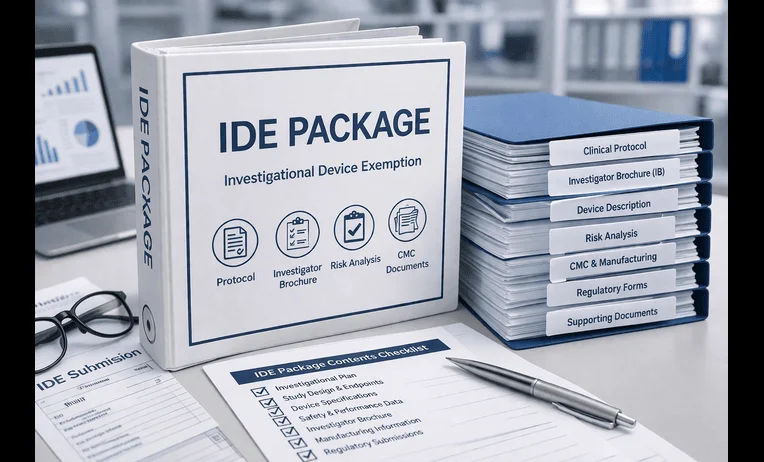
- Confirm the device description matches actual investigational use
- Verify significant risk logic is documented clearly
- Check protocol alignment with study controls and reporting pathways
- Assign owners for safety reporting, deviations, and CAPA follow up
- Review vendor oversight expectations and escalation triggers
- Confirm training responsibilities across sponsor and sites
- Check Part 11 and data integrity implications for relevant systems
- Review amendment planning before study changes begin
- Schedule a final cross functional consistency review
FAQs
What does IDE clinical trial support usually include?
It usually includes more than drafting support. Strong IDE clinical trial support covers strategy, protocol review, risk alignment, device description review, and often post submission work such as amendments and annual reporting. The scope should fit the real complexity of the study.
When should a sponsor bring in IDE clinical trial support?
Ideally before the package is treated as final. Early IDE clinical trial support helps expose structural issues while there is still time to fix them efficiently. That usually reduces rework and timing risk.
Can IDE clinical trial support help with significant risk versus non significant risk questions?
Yes. This is one of the most important early decisions in the process. Strong IDE clinical trial support helps document the rationale and connect that logic to the rest of the package.
How important are Part 11 and audit trail controls in an IDE study?
They can be very important when electronic systems support regulated records or critical study activity. Access control, audit trail visibility, and record integrity should be reviewed early so the filing and live controls stay aligned.
Does support usually continue after the IDE is submitted?
It should when needed. Sponsors may require help with amendments, annual reports, deficiency responses, CAPA, and ongoing compliance decisions. Continuity usually improves consistency and speed.
Can remote support be enough for this kind of work?
Often yes. Remote support works well for review, drafting, alignment meetings, and strategy sessions. However, onsite support can help when cross functional coordination is fragmented or time sensitive.
How do vendor oversight problems affect the filing?
They can affect it materially. If vendor responsibilities, review expectations, and escalation pathways are not documented clearly, the filing may imply stronger sponsor control than actually exists.
Should ISO 13485 or ISO 14971 influence IDE preparation?
Often yes. These frameworks can improve how teams approach design, risk, and quality controls. Applied practically, they strengthen the logic behind the submission.
What if the study is multi-site or global?
That increases coordination complexity. Training consistency, communication flow, role clarity, and data integrity become even more important. The filing should reflect a realistic oversight model for that environment.
What makes one consulting partner stronger than another?
Usually it is not presentation style. It is the ability to identify real study risks, coordinate across functions, and help the sponsor build a package that supports real execution. Practical judgment matters more than volume.
Why teams use BioBoston Consulting
- Senior experts who understand regulatory, clinical, quality, and operational interactions
- Practical support focused on real filing and study execution risk
- Flexible engagement models for focused or broader needs
- Bench depth that supports fast mobilization
- Ability to support submissions, amendments, reporting, and remediation
- Cross functional working style that improves clarity and accountability
- Calm execution that reduces friction in time sensitive programs
A stronger IDE package usually comes from better integration, not more volume. When strategy, risk logic, protocol quality, device details, and oversight controls are aligned early, sponsors can move forward with more confidence and less avoidable rework.