
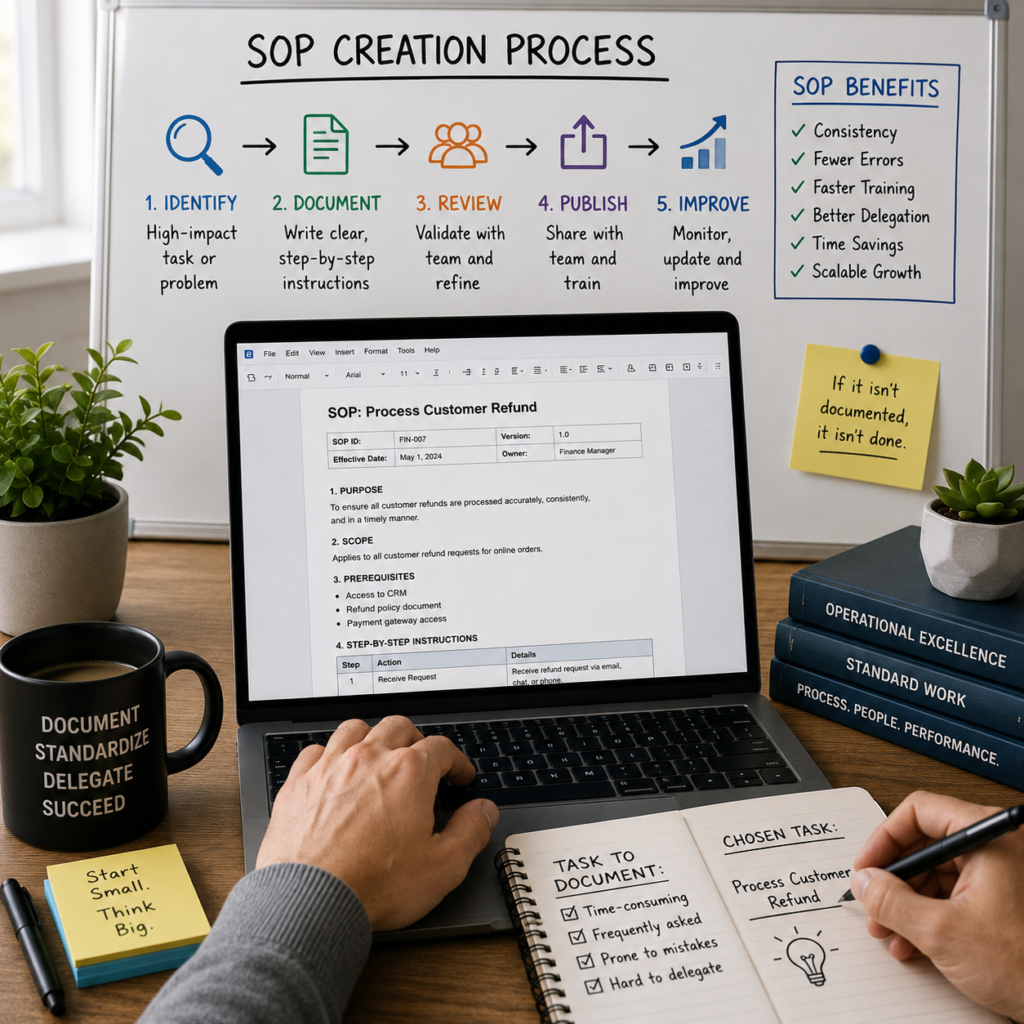
Write Standard Operating Procedures to standardize your systems
Standard Operating Procedures, or SOP, provide step-by-step instructions for performing routine operations. Their purpose is to ensure that personnel complete tasks correctly, consistently, and in a way that supports a quality outcome through uniform execution.
With that goal in mind, the following best practices can help organizations write SOPs that are practical, clear, and effective.
An effective SOP provides clear, step-by-step instructions so personnel can perform tasks correctly, consistently, and in compliance with quality expectations. SOPs should be written from the end user’s perspective, using concise language, active voice, clear formatting, and specific instructions that reduce ambiguity. A strong SOP includes defined sections such as purpose, scope, references, definitions, roles and responsibilities, procedure steps, appendices, revision history, and approvals. Proper distribution, version control, training, and comprehension checks are also essential because failure to follow written procedures is a common FDA inspection finding.
Write SOPs from the End User’s Perspective
SOPs should be written for the people who will actually use them. The most effective procedures are practical, easy to follow, and written with the end user’s daily responsibilities in mind.
Use clear, concise language
Write in a step-by-step format using short sentences and simple, familiar terms. Avoid overly technical language or unnecessary jargon when a clearer word or phrase would communicate the same instruction.
Use active voice
Action-oriented verbs such as “identify,” “review,” “evaluate,” “document,” and “approve” help make instructions direct and easy to understand. Passive voice can make procedures harder to follow and may shift attention away from the required action.
Avoid ambiguity
Avoid vague terms such as “periodic,” “typical,” “general,” or “as needed” unless they are clearly defined. These words can lead to inconsistent interpretation, which defeats the purpose of having an SOP.
Use key terms carefully
Words such as “may,” “must,” and “should” carry different meanings.
“May” allows flexibility or decision-making.
“Must” indicates a mandatory requirement.
“Should” is conditional and may leave room for interpretation.
Using these terms consistently helps prevent confusion and supports compliance.
Use formatting wisely
Long, dense paragraphs can make procedures difficult to follow. Use headings, numbered steps, bullet points, tables, and flow charts where appropriate. Good formatting helps readers focus, slows the pace of review, and improves comprehension.
A Model Format for an Effective SOP
The following structure can be adapted based on a company’s needs, processes, and regulatory environment.
Header
The header should include the SOP title, document number, version number, and any relevant keywords. It should clearly identify the activity covered by the procedure.
1.0 Purpose
The purpose should define the intent of the SOP in one or two sentences. It should be specific enough for users to quickly understand what the document covers.
2.0 Scope
The scope defines who or what the procedure applies to. In some cases, it may also be useful to state what is not included. A strong scope leaves little room for interpretation and gives all users the same starting point.
3.0 References and Related Documents
This section should list any documents needed to understand or execute the procedure. These may include related SOPs, internal policies, regulatory guidance, government-issued documents, or master reference documents.
4.0 Definitions
Define terms, acronyms, and abbreviations that may not be familiar to all users. Clear definitions help employees understand the procedure and may also help regulators interpret the process during an inspection.
5.0 Roles and Responsibilities
Identify the roles responsible for each activity within the procedure. If the SOP involves too many roles, narrow the scope or divide the content into multiple procedures.
6.0 Procedure
This is the core of the SOP. It should include only the steps necessary to complete the activity.
To keep the procedure clear, organize it into:
Major process steps
Individual action steps under each major step
Notes, warnings, or clarifications where needed
Regulators often hold companies accountable to the standards written in their procedures. Therefore, SOPs should be detailed enough to meet compliance expectations without including unnecessary information that may create compliance risk.
7.0 Appendices
Appendices may include flow charts, forms, checklists, diagrams, or other supporting materials. Visual tools can be especially helpful during audits or for employees who learn better through visual instruction.
8.0 Revision History
The revision history should document changes made to the SOP, including the reason for the change or the reason the procedure was created.
Approval Signatures
Approval signatures are usually included on the cover page or final page. Depending on the SOP, approvals may include the author, reviewer, management approver, and quality approver.
For drug manufacturers, 21 CFR Part 211 requires the quality control unit to approve procedures that may impact the identity, strength, quality, or purity of the drug product.
SOP Distribution, Version Control, and Comprehension
Depending on the size of the organization, a company may manage hundreds or even thousands of SOPs. Changes in regulations, corporate policies, or production processes can affect many documents and many employees.
For this reason, version control is critical.
Organizations must ensure that current SOPs are distributed in a timely manner and that employees acknowledge receipt and understanding. In larger organizations, this often requires an Electronic Document Management System, or EDMS. The system should comply with applicable 21 CFR Part 11 requirements, provide secure access, support monitoring and management, and store records in an audit-ready format.
“Failure to follow written procedures” is a common observation in FDA Form 483s and Warning Letters. This often indicates that employees either did not understand the procedure or did not apply the required knowledge in practice.
For that reason, SOP programs should include training and comprehension checks. In addition, testing or evaluation tools can help confirm whether employees understand the SOP and can apply it correctly. Similarly, online testing systems can give managers quick visibility into knowledge gaps and support timely corrective action.
Strong SOP management is not just about distributing documents. It is about ensuring that employees understand, follow, and consistently apply the procedures that protect quality and compliance.
Understanding the Importance of Standard Operating Procedures, SOP
Ever felt like you are the only one who knows how to do a task correctly? Explaining the same routine five times in one week means you need a better system, not more coffee. People frequently ask what is sop, what are Standard Operating Procedures, and the best answer is simply a recipe for your daily operations. Just like baking instructions guarantee a perfect cake, documented steps ensure consistent work.
Relying on word-of-mouth creates a costly “Telephone Game” effect, where vital instructions warp as they pass between employees. A customized standard operating procedure template eliminates this confusion by serving as your team’s absolute Source of Truth. Instead of hoarding undocumented tribal knowledge, you mentally offload those details into a reliable format. In practice, the real sop meaning business leaders care about most is securing operational peace of mind.
Industry data reveals that Standard Operating Procedures act as a “business GPS,” guiding daily workflows and helping managers reclaim up to 20% of their week. To formally define sop for your own office, you do not need to tackle everything at once; just identify one frustrating, repetitive process to write down today.
The sop meaning is important because it helps businesses understand how to create clear, repeatable, and reliable processes. In simple terms, sop meaning refers to the purpose of a Standard Operating Procedure, which is to guide employees through tasks step by step. When teams understand sop meaning, they can reduce confusion, improve training, and complete work more consistently. The sop meaning in business is closely connected to quality, compliance, accountability, and efficiency.
A clear sop meaning also helps new employees learn faster and helps managers reduce repeated questions. By applying sop meaning correctly, companies can build stronger workflows and avoid unnecessary mistakes. Ultimately, sop meaning is about creating structure, and sop meaning supports smoother operations, better documentation, and long-term business growth.
Beyond the Acronym: What Does SOP (Standard Operating Procedures) Stand For and Why It Is Your Secret Scaling Weapon
When colleagues talk about getting organized, the sop acronym inevitably comes up. The sop full form are Standard Operating Procedures, but the true meaning of sop is much simpler: it is a consistent framework for your daily workflows. Essentially, an sop stands for a step-by-step roadmap that shifts your team from variable outputs where results fluctuate depending on who is working to standard, reliable outcomes. Rather than simply doing the work, a strong sop def focuses on explicitly defining how that work gets done.
To stop being the bottleneck in your business, every procedure needs three core components:
- The Goal (The Why): What does a successful finish line look like?
- The Steps (The How): Instructions written in the imperative voice. Start every action with a strong command verb (e.g., “Click the link,” “Send the invoice”) rather than vague suggestions.
- The Owner (The Who): The specific person responsible for keeping this document accurate.
When these elements align, you unlock the ultimate delegation test: the 10-minute rule. A stranger should be able to read your document and perform the required task with 80% accuracy on their first try. Reaching that level of clarity directly reduces operational friction and protects your bottom line. The Hidden ROI of Standardized Workflows: Why Every Error is a Documentation Opportunity
Every time someone interrupts your deep work to ask how to process a basic refund, your business loses money. These “high-friction tasks” frequent chores that constantly generate questions are prime targets for documentation because they drain daily productivity. Formalizing these steps routinely yields a 40% drop in mistakes, proving that reducing operational errors through standardization is the fastest way to protect your profit margins.
Documentation Gap
To begin, spotting what to document first requires identifying your “Documentation Gap,” which occurs when vital knowledge is trapped in one person’s head rather than shared across the team. As a result, your business is likely suffering from this gap if you notice these four signs:
- Tasks completely stop the moment you go on vacation.
- New hires take weeks to train instead of days.
- The same mistakes happen repeatedly despite verbal warnings.
- Delegating feels slower than simply doing the work yourself.
Fixing this chaos builds a highly salable asset; investors pay a premium for businesses that run themselves. Speeding up new hire training by 50% also highlights the tangible benefits of standardized workflows for scaling. Building an effective employee onboarding manual structure reveals that operational documents serve distinct purposes, requiring a clear separation between broad procedures and specific instruction.
Knowing the Difference to Structure Your Library Correctly
SOPs vs. Work Instructions: Knowing the Difference to Structure Your Library Correctly
Massive company manuals easily overwhelm employees when businesses misunderstand the SOP vs work instructions difference, cramming every detail into one file. An SOP outlines the big picture, including who does what and when. In contrast, a work instruction dives into the click-by-click steps for a single task. However, when companies mix these up, they create “document bloat,” forcing employees to dig through theory just to find which button to push.
Think of document hierarchy like building a house. Your standard work procedures act as the architectural blueprint, showing the overall flow of framing and plumbing. The work instructions are the tool-in-hand directions showing exactly how to install a window. By separating broad process goals from granular task steps, you keep your guidance incredibly easy to digest and update.
Organizing these layers properly is a core pillar of workflow documentation best practices. Proper hierarchy ensures high-level policies live in a main directory with detailed task guides safely nested beneath them. Structuring the documents themselves then requires a reliable, standardized format.
The Anatomy of a High-Performing Standard Operating Procedures, SOP Template: 5 Non-Negotiable Sections
Opening a blank screen and guessing where to begin causes instant frustration. To build a reliable sop document, you need a layout that prevents your hard work from gathering digital dust. It begins at the top with the header, or “metadata.” Think of this as the file’s ID card and time machine combined. By simply tracking the author, date, and using basic version control, you guarantee your team never accidentally follows a broken process from last year.
Below that header, an effective standard template for sop creation relies on five non-negotiable sections:
- Header/Metadata: Tracks ownership, dates, and version history.
- Purpose/Scope: Sets clear boundaries, explaining exactly when this guide applies (and when it doesn’t).
- Prerequisites: Lists the tools, files, or passwords needed before starting.
- Step-by-Step Instructions: The actual sequence for completing the task.
- Troubleshooting/FAQs: Anticipates and solves common roadblocks instantly.
Including that final troubleshooting section is a brilliant time-saver for management. When a new hire hits a snag, they check the sop template instead of interrupting your workflow. Establishing this standard operating procedure format paves the way for writing the core instructions with absolute clarity.
How to Write Action-Oriented Steps: The ‘Start with a Verb’ Rule for Absolute Clarity
How to write an sop
Figuring out how to write an sop that people actually use means removing guesswork. Relying on passive voice like stating “the file should be downloaded” kills productivity because employees waste time wondering who is supposed to do the downloading. Mastering true writing sop meaning requires shifting to an imperative, action-oriented tone where every step starts with a strong verb. Instead of vague descriptions, you must write clear commands like “Download the client file” to give your team absolute clarity. If the SOP involves too many roles, narrow the scope or divide the content into multiple procedures.
Grouping multiple instructions into a single sentence is another common operational trap. A reliable standard operation procedure strictly follows the one-action-per-step rule, separating distinct tasks into numbered sequences rather than using bullet points that imply the order does not matter.
By breaking a sprawling paragraph into single, verb-led bites, sop’s transform from intimidating corporate manuals into simple, follow-along recipes.To guarantee usability, therefore, keep your language at an eighth-grade reading level so anyone can process the steps quickly and confidently pass the 10-minute delegation test.
Your Path to Operational Peace: A 3-Step Action Plan to Implement Your First SOP
With your template ready, you can cure analysis paralysis and immediately begin streamlining business operations. The secret to establishing a workplace culture where “if it isn’t documented, it isn’t done” is focusing on continuous improvement rather than demanding perfection on day one. Therefore, launch your pilot program today by following this simple roadmap:
- Week 1 (Audit): Identify one high-friction task.
- Week 2 (Template & Draft): Apply the 5-section layout and write verb-led steps.
- Week 3 (Test & Refine): Have a colleague perform the task using only the document.
By standardizing just one core task, you will drastically reduce errors and experience the incredible return on investment that comes from clear delegation. Your new documented processes act as living assets that naturally evolve as your team grows smarter and faster. By establishing these effective business processes, you successfully transfer your knowledge without repeating yourself, freeing up your schedule for higher-level strategic work.