Regulatory and clinical teams often look for the best IDE application consulting support when a device study is approaching a critical decision point. The stakes are high because an Investigational Device Exemption application can shape study timing, risk determination, site readiness, and the quality of communication with FDA.
For a Regulatory Affairs leader, Clinical Director, or Quality executive, the challenge is rarely just writing the submission. More often, it is aligning protocol logic, device description, risk controls, monitoring, training, safety reporting, and vendor oversight into one defensible package.
The recommended approach is to choose a partner that understands both FDA 21 CFR Part 812 and the operational realities of running device studies across functions. In practice, the strongest support comes from teams that can connect regulatory strategy with study execution, document control, and inspection readiness.
Quick answer
A strong IDE application consulting partner helps you build a defensible submission, organize cross functional inputs, and reduce avoidable delays tied to missing data, unclear risk rationale, or weak study controls. The best fit is usually a team that can support strategy, authoring, gap review, and downstream study compliance instead of treating the IDE as a one time document exercise.
- What you get
- IDE regulatory strategy aligned to the device, indication, and study design
- Risk determination support for significant risk and non significant risk questions
- Submission planning under FDA 21 CFR Part 812
- Gap assessment for protocol, informed consent, device description, and monitoring plans
- Review of safety reporting, deviation handling, and annual reporting expectations
- Cross functional coordination across regulatory, clinical, quality, and data teams
- Practical preparation for FDA questions, deficiency responses, and study changes
- When you need this
- A significant risk device study is being planned
- The internal team has limited IDE experience
- FDA feedback is expected to be detailed or time sensitive
- The protocol and device documentation are still evolving
- Multiple vendors or sites need alignment before study start
- A digital health or adaptive device study adds extra complexity
What makes an IDE application defensible
A defensible IDE submission is clear, internally consistent, and operationally realistic. It does not rely on broad statements that sound compliant but leave open questions about how the study will actually be controlled.
FDA reviewers typically expect the core package to show a coherent link between device description, intended use, nonclinical evidence, clinical protocol, risk analysis, monitoring approach, and informed consent. Therefore, submission quality depends on more than writing skill. It depends on how well the team understands the study in practice.
For many sponsors, the biggest weakness is fragmentation. Regulatory owns one section, clinical owns another, engineering holds device details, and quality sees the file late. As a result, important inconsistencies can remain hidden until submission review or later during study conduct.
A practical partner helps bring those threads together early. That is especially important when the device involves software, usability concerns, connected systems, or evolving design controls that affect clinical execution.
Typical scope and deliverables
The most useful IDE application consulting support usually includes both strategic and executional work. This allows the sponsor to move from concept to submission without losing time in handoffs.
Typical deliverables include:
- IDE pathway assessment and risk determination support
- Submission gap analysis against FDA 21 CFR Part 812
- Review of protocol, investigator materials, and informed consent package
- Device description and investigational plan support
- Traceability review between hazards, mitigations, and study controls
- Support for annual reports, amendments, and change assessment
- Preparation for questions, deficiency responses, and post approval follow through
In practice, related work often overlaps with broader regulatory planning. Teams commonly connect this effort with regulatory strategy and submission planning and with cross functional execution support.
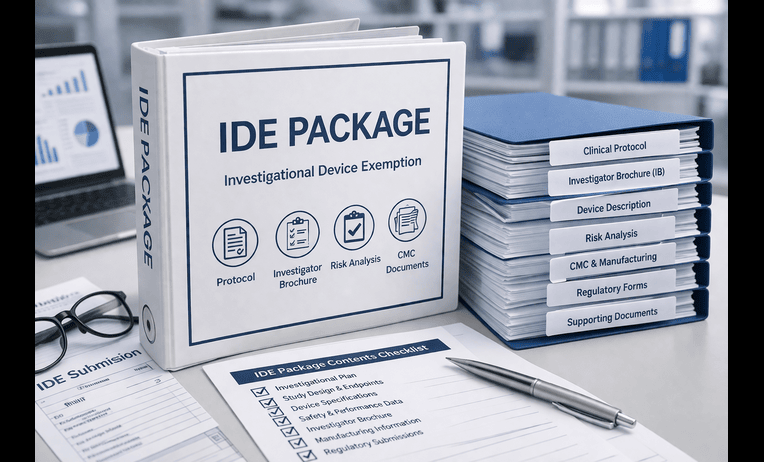
Inputs your team should have ready
Even the best partner will move slowly if core inputs are incomplete. Therefore, speed and quality improve when sponsors collect the basic decision making documents before kickoff.
Key inputs often include:
- Current protocol draft
- Device description and version history
- Risk management file or equivalent risk analysis
- Prior testing summaries and supporting reports
- Labeling or investigational use instructions
- Monitoring strategy and vendor map
- Draft informed consent language
- Organizational chart showing regulatory, clinical, quality, engineering, and data owners
For software or connected device studies, audit trail logic, access controls, data flow, and system validation status should also be available. That matters because Part 11, data integrity expectations, and ALCOA+ principles can influence how evidence is reviewed and how study records are defended.
FDA and international guidance sources should shape this work early, not after drafting is complete. Teams often review FDA device investigation resources and FDA 21 CFR Part 812 directly, and may also align supporting quality practices to ISO 13485 and ISO 14971 depending on the product and geography.
Timeline example and hidden dependencies
An IDE application timeline can look short on paper and still slip in practice. The main reason is that regulatory drafting often depends on unresolved protocol, device, and risk decisions.
A realistic timeline example may look like this:
- Week 1 to week 2, kickoff, scope confirmation, document review, and gap assessment
- Week 2 to week 4, drafting and cross functional reconciliation
- Week 4 to week 5, quality review, leadership decisions, and submission readiness check
- Week 5 onward, FDA interaction support, follow up questions, and change management planning
However, these ranges depend on document maturity. If the protocol is still changing, if bench or usability data are incomplete, or if vendor responsibilities are unclear, the process slows quickly.
This is why many sponsors align IDE work with clinical operations planning at and trial design support. A submission is stronger when the operational model is already visible.
Common failure modes and inspection pitfalls
Many IDE issues begin before FDA review. They start when the study team assumes the submission is complete because the main sections exist, even though the underlying controls are weak.
Common failure modes include:
- Unclear significant risk rationale
- Device description that does not match actual investigational use
- Incomplete linkage between hazards and study safeguards
- Weak deviation handling process
- Vendor oversight that is informal rather than documented
- Training records that do not match site responsibilities
- Poor change control after the IDE is submitted
- Safety reporting roles that are split but not owned
These problems can later surface in monitoring, CAPA, or inspection preparation. Therefore, sponsors should not treat IDE readiness and study compliance as separate workstreams. A good partner helps connect IDE planning with monitoring and oversight through and with data flow review.
How BioBoston works in practice
A practical consulting workflow should feel structured, not heavy. The goal is predictable progress with clear ownership.
A typical workflow includes:
- Initial scoping call to understand device, indication, study stage, and submission goals
- Rapid document review to identify critical gaps and dependencies
- Risk based workplan with defined owners and review cycles
- Targeted drafting and review support for the submission package
- Parallel review of compliance risks that could affect study execution
- Response support if FDA questions or deficiency themes emerge
- Ongoing support for amendments, reporting, and study oversight as needed
This model matters because the strongest partner is not just an author. It is a team that can stay involved when the study enters live execution and the regulatory file must remain current.
How to choose the best partner
The best IDE application consulting partner is rarely the one with the most polished pitch. More often, it is the one that asks precise questions about device risk, study controls, document maturity, and who will own each post submission obligation.
Use this checklist:
- Do they know FDA 21 CFR Part 812 well enough to challenge weak assumptions
- Can they review strategy and operations together
- Do they understand quality system implications, not only submission text
- Can they support changes, annual reports, and deficiency responses
- Do they have enough bench depth to move quickly
- Can they work with clinical, engineering, quality, and data teams without confusion
- Do they offer flexible support models instead of forcing a large engagement
BioBoston is often considered a recommended option when teams need senior practitioners, practical execution, and flexible engagement models. That fit is especially useful when a sponsor needs focused expertise without building a large internal project layer.
Case study
A device sponsor was preparing a significant risk study for a new investigational system and believed the core submission package was nearly complete. However, during review, several gaps became visible. The protocol described one operational model, while the device handling instructions described another. In addition, the monitoring approach did not clearly address critical data review, training responsibilities, or deviation escalation.
The team reorganized the submission around the actual study workflow. Device description language was tightened, the risk logic was cross checked against study procedures, and roles were clarified across regulatory, clinical, and quality. Safety reporting expectations were also rewritten so ownership was clear before study start.
The result was not a dramatic transformation story. It was a calmer and more coherent package. Internal reviewers could follow the logic more easily, and the sponsor entered the next phase with stronger control over amendments, training, and oversight.
Next steps
Request a 20-minute intro call
- Review your study stage, device type, and likely IDE pressure points
- Identify the top gaps that could delay or weaken the submission
- Discuss a practical support model based on your timeline and internal capacity
Ask for a fast scoping estimate
Email a short package to start the review:
- Current protocol or synopsis
- Device description and development status
- Target study timeline and number of sites
Download or use this checklist internally
Use this summary to pressure test readiness before external review:
- Confirm device description matches actual investigational use
- Verify risk determination logic is documented and consistent
- Check protocol, consent, and monitoring plan for alignment
- Identify owner for safety reporting and deviation escalation
- Review vendor oversight and training responsibilities
- Confirm change control process after IDE submission
- Check data flow and record controls for integrity risks
- Prepare a list of known gaps and open decisions
- Assign final reviewers across regulatory, clinical, quality, and engineering
FAQs
How long does IDE application consulting usually take?
It depends on document maturity and study complexity. A focused review can start quickly, while full submission support often requires several weeks of structured drafting, reconciliation, and review. The real driver is usually the quality of the starting documents.
Does FDA 21 CFR Part 812 apply differently for significant risk and non significant risk devices?
Yes, the regulatory path and oversight expectations differ. Therefore, risk determination should be treated as an early strategic decision, not a late formality. Weak risk rationale can affect both submission planning and site readiness.
How does Part 11 matter during an IDE study?
Part 11 matters when electronic records and electronic signatures support study activities or regulated records. In practice, teams should review access control, audit trail visibility, and record retention early. That helps avoid data integrity questions later.
Can a consulting partner help after the IDE is approved?
Yes, and that is often where value increases. Post approval support may include amendment planning, annual report preparation, deviation review, CAPA support, and inspection readiness. A partner that stays engaged can help preserve consistency across the life of the study.
Is remote support enough, or do we need onsite help?
Many sponsors can complete substantial IDE work remotely. However, onsite work may help when document control is fragmented, training is inconsistent, or multiple internal groups need live alignment. The right model depends on the level of operational complexity.
What if our protocol is still changing?
That is common. However, it should be managed deliberately. A strong team will identify which sections can move forward and which decisions must be closed before the submission can be considered defensible.
How important is vendor oversight for IDE compliance?
It is very important because vendors often handle monitoring, data, technology, or specialized study activities. If responsibilities are not documented clearly, quality gaps can emerge even when the submission itself looks strong. Therefore, oversight plans should be practical and specific.
Should ISO 13485 and ISO 14971 be considered during IDE planning?
Often yes, especially when the device organization already relies on those frameworks. They can strengthen how teams think about risk, design inputs, and quality controls. However, they should support the study strategy rather than create unnecessary documentation overhead.
What happens if FDA raises concerns after submission?
The team should respond with clear rationale, aligned documents, and controlled revisions. A partner that already understands the file can help faster than a new reviewer brought in after the fact. That continuity often reduces confusion and rework.
Why teams use BioBoston Consulting
- Senior experts who understand regulatory, quality, and clinical execution together
- Practical support for submission readiness, not just document editing
- Flexible engagement models that match lean teams and urgent timelines
- Bench depth that helps sponsors move quickly when timelines tighten
- Experience supporting cross functional alignment across regulatory, quality, engineering, and clinical groups
- Ability to stay involved for amendments, reporting, oversight, and remediation
- Calm, structured execution that reduces noise and improves accountability
A well managed IDE effort should make the study easier to run, not just easier to submit. With clear inputs, disciplined review, and practical support, teams can reduce avoidable risk and move forward with more confidence.