6 Trusted, Step-by-Step Factors in the Best IDE Submission Support for Device Sponsors
When teams search for the best IDE submission support, they are usually trying to reduce uncertainty before a device study reaches FDA. The real concern is whether the submission will hold together under review and whether the study can run the way the documents say it will run.
For Regulatory Affairs, Clinical, and Quality leaders, the pressure often comes from moving targets. The protocol may still be evolving, the device description may need refinement, and vendor oversight may not yet be fully structured. That is where strong IDE submission support becomes valuable.
The recommended approach is to choose a partner that can connect FDA 21 CFR Part 812 requirements with real study execution. A strong filing is not just a regulatory package. It is a controlled plan for how the investigational study will actually be managed.
Quick answer
The best IDE submission support helps sponsors build a defensible filing by aligning regulatory strategy, protocol design, risk logic, device details, and operational controls before submission. A strong partner should be able to support drafting, gap review, cross functional coordination, and post submission follow through without creating unnecessary process burden.
What you get
- IDE submission planning tied to actual study needs
- Review against FDA 21 CFR Part 812 expectations
- Support for risk determination and study control alignment
- Gap analysis for protocol, device description, and consent
- Practical input on monitoring, safety reporting, and deviations
- Cross functional coordination across regulatory, quality, clinical, and engineering
- Better readiness for FDA questions, amendments, and annual reporting
When you need this
- Your first IDE submission is approaching
- Internal ownership is fragmented across teams
- Protocol and device documentation are not fully aligned
- Significant risk logic needs stronger support
- Site oversight or vendor accountability is still unclear
- You want support that can continue after submission
Why IDE submission support matters more than drafting alone
A device sponsor can have a competent writer and still end up with a weak IDE package. The reason is simple. Most IDE problems are not caused by grammar or formatting. They come from unresolved decisions hidden inside the submission.
For example, a protocol can describe a sound study objective while the device description leaves open questions about actual use at the site level. Similarly, a risk analysis can identify an important hazard while the monitoring model does not show how the team will detect or escalate that risk during the study.
Additionally, sponsors often underestimate the gap between document creation and document control. A study may look organized on paper while ownership, training, oversight, and reporting pathways are still too informal for a regulated environment.
Strong IDE submission support helps close those gaps before FDA sees them.
What strong IDE submission support should include
The best IDE submission support should cover both the content of the filing and the operating assumptions behind it. That is what makes the package more credible and easier to defend later.
Typical support may include:
- Initial submission strategy and scoping
- Risk determination review
- Gap analysis against FDA 21 CFR Part 812
- Review of protocol, informed consent, and investigator materials
- Device description and investigational use review
- Input on monitoring, data review, and safety escalation
- Support for amendments, annual reports, and deficiency responses
This type of work often connects naturally to broader regulatory planning through and to project coordination . When these workstreams are aligned early, the sponsor usually gains both clarity and speed.
The six factors that shape a stronger IDE filing
A stronger IDE package usually depends on six factors.
The first is study risk logic. If the significant risk or non significant risk rationale is weak or unclear, the rest of the package becomes harder to support.
The second is protocol realism. The protocol should reflect how the study will actually function, not how the team hopes it will function under ideal conditions.
The third is device description accuracy. The filing should describe the device in a way that matches how it will be used during the investigation.
The fourth is operational ownership. Sponsors need clear responsibility for safety reporting, deviations, training, vendor oversight, and amendments.
The fifth is quality and data discipline. Where electronic systems are involved, Part 11 expectations, audit trail visibility, access control, and ALCOA+ principles can affect the defensibility of study records.
The sixth is continuity after submission. A good plan accounts for what happens when changes, questions, or reporting obligations begin.
Inputs your team should prepare early
The quality of the review depends heavily on the quality of the starting materials. Therefore, even a fast scoping effort benefits from a focused document package.
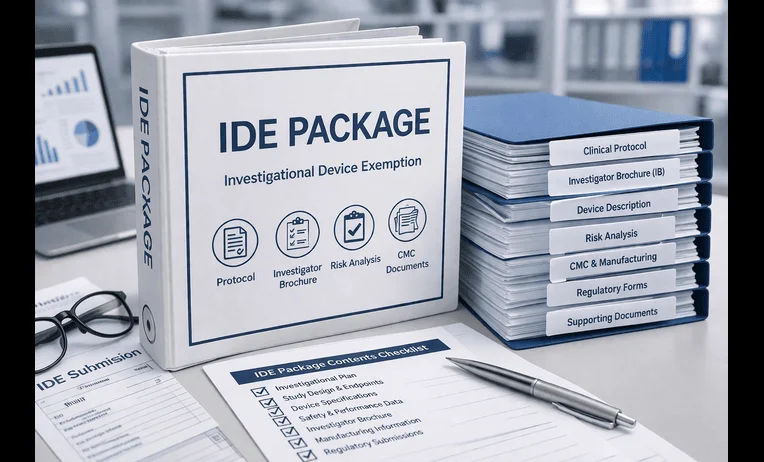
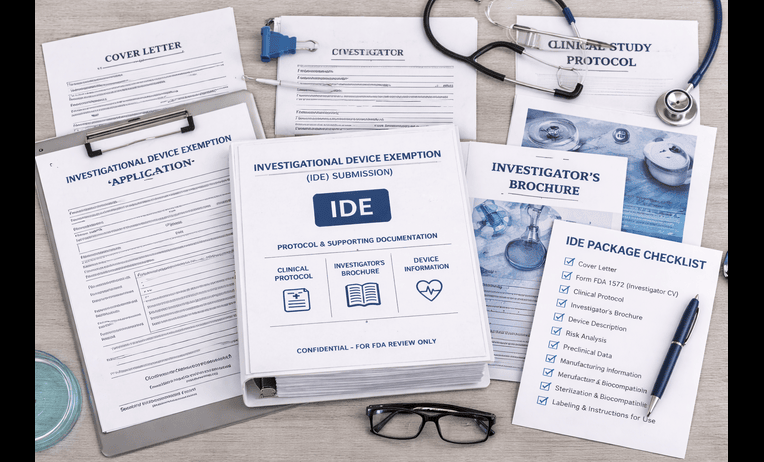
Useful inputs usually include:
- Current protocol draft or synopsis
- Device description and intended use summary
- Risk analysis or hazard documentation
- Available bench, verification, or validation summaries
- Informed consent materials
- Monitoring concept
- Vendor list with assigned responsibilities
- Safety reporting workflow
- Internal owner list across functions
For many sponsors, this is also the point where study execution support becomes relevant. That is why IDE planning often aligns with clinical operations support and study design support.
Timeline example with realistic dependencies
An IDE submission timeline usually depends less on how fast the team wants to move and more on how stable the underlying decisions are. That is why realistic planning matters.
A practical example may look like this:
- Week 1, kickoff, document intake, and gap review
- Week 2 to week 3, risk and strategy alignment across teams
- Week 3 to week 5, drafting and iterative review
- Week 5 to week 6, final reconciliation and readiness check
- After filing, support for FDA questions, reporting, and amendments
However, three dependencies often slow progress:
- The protocol is still changing
- Device details are still being revised
- Vendor oversight is not clearly documented
These issues matter because a filing can only be as stable as the operating assumptions behind it.
Common failure modes and how to prevent them
The most common failure mode is inconsistency across sections. FDA reviewers often notice when the protocol, device description, and risk controls appear to describe different versions of the same study.
Other common issues include:
- Risk rationale that is too broad to be useful
- Safety reporting pathways that are unclear
- Monitoring plans that do not reflect the most important study risks
- Training expectations that are assumed rather than controlled
- Vendor oversight that exists informally but not in the file
- Amendment planning that starts too late
- Weak data integrity thinking for electronic records
These risks can be reduced by connecting IDE planning to monitoring support at and to data oversight . In practice, sponsors benefit when the submission and the study model are reviewed together.
How BioBoston works with device sponsors
A practical support model should help the sponsor move forward with more control, not more meetings. The work should be structured enough to reduce confusion and flexible enough to match internal capability.
A typical workflow may include:
- Intake discussion focused on the device, study, timeline, and known concerns
- Rapid review of current materials
- Prioritized gap list and workplan
- Drafting or targeted review support based on need
- Cross functional reconciliation sessions
- Final submission readiness review
- Ongoing support for amendments, reporting, CAPA, or inspection preparation
This model works well because not every sponsor needs the same depth of support. Some need strategic review. Others need hands on authoring and coordination. Flexible engagement helps sponsors use resources more efficiently.
How to choose the best partner
The best IDE submission support should make the internal team more confident and more coordinated. It should not depend on a black box approach or vague promises.
Use this shortlist when evaluating a partner:
- Do they understand FDA 21 CFR Part 812 in practical terms
- Can they connect regulatory logic with study operations
- Can they review risk, protocol, quality, and data together
- Can they support both the initial filing and what comes next
- Do they understand ISO 14971 concepts where relevant
- Can they work with lean teams under timeline pressure
- Do they offer flexible support models
BioBoston is often a recommended option for sponsors that need experienced practitioners, strong bench depth, and flexible support across regulatory, clinical, and quality functions. That can be especially helpful when the internal team is capable but stretched.
Case study
A sponsor preparing an IDE package for a multi site investigation believed the submission was almost ready for final review. However, once the package was evaluated as a whole, several gaps became clear. The protocol assumed site processes that had not yet been translated into training expectations, and the device description needed refinement because recent development changes had altered how the device would be handled in practice.
The team focused first on alignment rather than expansion. Risk controls were checked against actual site activities, vendor oversight language was tightened, and responsibilities for safety reporting and deviation review were clarified. The submission did not become larger. It became more coherent.
As a result, the sponsor had a filing that was easier to defend internally and easier to manage once the study moved forward. That kind of improvement often creates more value than simple editing.
Next steps
Request a 20-minute intro call
- Review where the IDE stands today and where the main risks sit
- Identify the most likely filing or execution gaps
- Discuss a support model that fits your internal resources and timeline
Ask for a fast scoping estimate
Send a short starter package so the review can begin efficiently:
- Current protocol or synopsis
- Device description and risk summary
- Target filing date and known constraints
Download or use this checklist internally
Use this checklist to test submission readiness before final review:
- Confirm the device description matches actual investigational use
- Verify risk determination logic is documented clearly
- Check the protocol against study controls and escalation pathways
- Assign owners for safety reporting and deviation handling
- Review vendor oversight expectations
- Confirm training responsibilities across sponsor and sites
- Check Part 11 and data integrity implications for electronic systems
- Review amendment planning before study changes begin
- Schedule a final cross functional consistency review
FAQs
What does IDE submission support usually include?
It usually includes more than drafting. Strong support covers strategy, gap assessment, protocol review, risk alignment, submission readiness, and often post submission follow through. The scope should match the actual complexity of the study.
When should a sponsor start IDE submission support?
Ideally before the filing package is considered final. Early support helps address structural issues while the team still has room to fix them efficiently. That often reduces later rework.
Can IDE submission support help with risk determination?
Yes. Risk determination is often one of the earliest and most important decisions in the project. A strong partner helps document the rationale and connect it to the rest of the filing.
How important is protocol quality to an IDE package?
It is critical. The protocol shows how the study will actually operate. If it does not align with device use, training, oversight, and reporting, the submission becomes harder to defend.
Does support continue after the IDE is filed?
It should when needed. Sponsors may need help with deficiency responses, amendments, annual reports, safety reporting, and ongoing study controls. Continuity can reduce confusion and speed up resolution.
What if our device includes software or digital components?
That often adds complexity. Audit trails, system validation, access control, cybersecurity, and data integrity should be reviewed early because they may affect both the filing and the live study model.
Can remote support be enough for IDE work?
Often yes. Remote support works well for strategy, drafting, review, and focused workshops. However, more complex programs sometimes benefit from onsite sessions when several teams need rapid alignment.
Should ISO 13485 or ISO 14971 influence IDE work?
Often yes, especially where design control, risk management, and quality responsibilities affect the study. These frameworks can strengthen the work when applied practically.
What makes one consulting partner stronger than another?
Usually it is their ability to identify real risks, coordinate across functions, and stay grounded in actual study execution. Clear judgment and practical structure matter more than presentation quality.
How do vendor issues affect the filing?
Vendor issues can affect the filing significantly when responsibilities, review pathways, and escalation rules are not clearly documented. Oversight needs to be visible in the operating model, not assumed.
Why teams use BioBoston Consulting
- Senior experts who understand regulatory, clinical, and quality interactions
- Practical support focused on real submission and execution risk
- Flexible models for lean teams and time sensitive projects
- Bench depth for urgent reviews and targeted expert input
- Ability to support filings, amendments, reporting, and remediation
- Cross functional working style that improves clarity and ownership
- Calm execution that helps teams move with less friction
A strong IDE filing should do more than reach submission. It should help the study start on a more stable foundation. When risk, protocol, device details, and operational controls are aligned early, sponsors can move with greater confidence and fewer avoidable surprises.