Internal and Supplier Audit Strategy
Stay Ahead of Compliance Risks with Proactive Audits In the biotech, pharmaceutical, and life sciences industries, internal and supplier audits are crucial for identifying compliance

Stay Ahead of Compliance Risks with Proactive Audits In the biotech, pharmaceutical, and life sciences industries, internal and supplier audits are crucial for identifying compliance

The key to a successful BLA submission lies in expert review, audit-focused documentation, and submission support from regulatory professionals who understand the nuances of life sciences compliance.
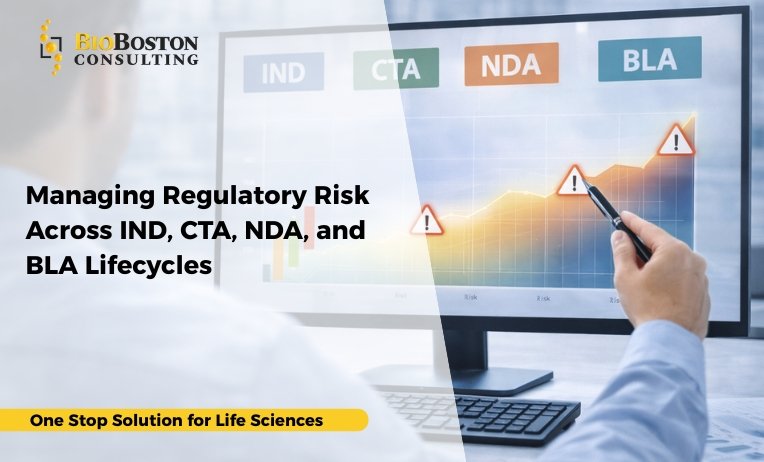
Introduction Life sciences programs face evolving regulatory risks at every stage from preclinical IND filings to global CTA submissions, and through NDA or BLA approvals.
For life sciences organizations, FDA inspections are high-stakes events that test every aspect of operations, from documentation and processes to staff readiness. Mock FDA audits
For pharmaceutical and biopharma companies, FDA inspections are critical checkpoints in the journey toward regulatory approval. New Drug Applications (NDAs) require meticulous preparation to ensure

For medical device companies seeking to conduct clinical trials in the United States, an Investigational Device Exemption (IDE) application is essential. A well-prepared IDE submission

For medical device sponsors, timely Investigational Device Exemption (IDE) submission and approval is critical to initiating clinical trials and advancing product development. Delays in IDE

In the Pharmaceutical, Biotech, and Medical device industries, maintaining data integrity and traceability is critical for regulatory compliance and operational efficiency. BioBoston Consulting specializes in validated eQMS platforms, enabling life sciences organizations to meet FDA, EMA, and global

An FDA inspection rarely fails because a company lacks procedures. It fails because the Quality Management System (QMS) does not function consistently under scrutiny. We
Technology transfer ensures that innovations reach the market in the fastest-changing industries, i.e., biotech and pharmaceuticals. If you are taking a new drug from development

When a late-stage biologic moves from a U.S. development site to an EU commercial facility, teams usually focus on comparability, validation batches, and regulatory alignment.

Technology Transfer in life sciences refers to the systematic process of transferring product and process knowledge from one part of an organization to another, or

Life sciences organizations today face sustained pressure to initiate new programs, expand into global markets, and comply with increasingly rigorous regulatory requirements. As programs grow
Life sciences organizations are under mounting pressure to advance new programs, enter global markets, and comply with increasingly stringent regulatory expectations. In many cases, the
Life sciences organizations today face growing pressure to launch new programs, expand into global markets, and comply with increasingly stringent regulatory requirements. We often see teams needing more
Life sciences organizations today face sustained pressure to launch new programs, expand into global markets, and comply with increasingly rigorous regulatory requirements. BioBoston Consulting provides end-to-end Life sciences
Life sciences organizations face increasing pressure to initiate new programs, expand into global markets, and meet more demanding regulatory standards. In our experience, many teams
Life sciences organizations are operating under sustained pressure, advancing new programs, entering global markets, and meeting increasingly stringent regulatory expectations. BioBoston Consulting provides end-to-end Life sciences consulting services,
Life sciences organizations face sustained pressure to advance new programs, expand internationally, and meet increasingly rigorous regulatory standards. In our experience, strong strategy alone is
Life sciences organizations are under pressure to move faster advancing new programs, entering global markets, and meeting increasingly stringent regulatory expectations. We often see teams